Wednesday, 25 July 2018

SYDNEY FILM FESTIVAL 2018.

The 2018 event raises the question of what does the State (the country’s?) best attended
movie event does now and what purpose, beyond pulling in enough money to meet the pay
roll, does it serve.

The matter was dramatised by my having four minutes to get from Nuri Bilge Ceylan’s
Ahlat Agaci / The Wild Pear Tree, a long, solemn, portentous Turkish drama from it’s
celebrity director in Chehovian mood, to Richard Kuipers presentation of Jen Wexler‘s
The Ranger, a standard issue slasher film with homicidal park ranger Jeremy Holm
chopping up punk kids in the menacing woods. It would be hard to find two people on the
planet, let alone in their audience, who would be at ease with both of those.

The idea that the Sydney Film Festival was picking out the year’s best work for a discriminating audience was always bogus. The current National Weeks making their countries’ hits accessible have showed that. What we have now is an event that is trendy enough to draw people, who would normally ignore them, into a cross section of the films that play on the international festival circuit. Not having cinematheques and specialised viewing groups here, there is no informed core audience, so maybe this scatter gun
approach is the best way to go. It’s  no fair swap however - as can be seen by the local films and movie journalism that result here. Meanwhile poor old Sydney Film Festival gets stick both for films that are obscure like Lav Diaz’ Filippino Ang panahon ng halimaw and for films that are too commercial, like the Japanese The Blood of Wolves but that’s their problem.

Considering the films on show in more detail, Ceylan’s Wild Pear Tree is ultimately three
hours plus of misery and indecisiveness wrapped around those literary clichés the shift to
adulthood and the young artist trapped in a crass society.

Recalling the subject matter of the director’s first film Kasaba / The Town, we get
swarthy Dogu Demirkol (debut) coming back from Çanakkale university to Car, his small
Anatolian town, to find his parents in debt, after school teacher father Murat Cemcir ’s
betting shop addiction, his mother and sister glumly watching TV soaps and storing the
food in the neighbour’s refrigerator when they can’t pay the elecricity bill. There is the
heavy handedly symbolic business of digging a dry well on the grandfather’s farm which
keeps on figuring in the thinks insets.

Demirkol’s ambitions as writer are a subject of indifference all round. He is praised by
the mayor and the the businessman he is referred to for sponsorship but it proves that they
are only interested in bankrolling tourist promotions related to local connection to the site
of the Gallippoli campaign and historic Troy. At one stage Demirkol takes refuge in a
wooden horse, left over from the Wolfgang Peterson movie.

Going off to Çanakkale for teacher examinations he hasn’t prepared, our hero spots
celebrity regional author Keskin in the book shop and in one of the film’s signature
tracking shot dialogues he follows the  writer into the street and along the waterfront
finally annoying the man to the point where he tells him their conversation, a cry for the
stimulation the young man desperately seeks, has just been an annoyance delaying a hot
foot bath. The man says the same thing as Cemcir will later - life is more important than
art.

A second long ambulatory dialogue has our hero find the pair of local Imans poaching
apples, exploitative Akin Aksu (co-script writer with the director and his wife) who
borrows gold without repayment and rings in the lead’s eighty year old former preacher
granddad to recite the service while he pursues other interests and his young colleague
Öner Erkan. Conversation turns on the literal truth of the Koran (“Can you run a tractor
without the manual?”) “The prophet said the ages will get worse and worse till
doomsday.”

The specter of life in the country’s frozen North either in impoverished schools or as (one
shot) a soldier in the snow, menaces the young man. Demirkol finds on his return his self
published, books have become moldy stacks in the cellar and once they got dad’s
superannuation, the family turned him out. In a simplistic ending the father is the only
one to appreciate the book.

Sharp ‘scope scenic images locate the piece. Lots of shots of the backs of heads, insets of
the baby covered with ants, ropes suggestive of hanging, a glimpse of the name tree. 

By contrast, The Ranger’s back story has the little girl retrieved from the meal Holm
prepares with his menacing Bowie knife and growing up to be pink haired Chloe Levine,
partner to a knife wielding dope pusher. The film is suitably gross with the leg-missing
amputee trying to figure how to drive his van or Levine, the bleeding needle puncture
marks in her arm, being told they were going to “strip the city from your bones.”

Gun shots on the edits, country and western and disco on the track, crisp location
camerawork and a nice appearance of a timber wolf. This one is right for it’s target
audience.

Australian Benjamin Gilmour’s Jirga reaches us with the big sell, a cover story in the
Weekend Herald Magazine, a Sydney Film Festival premiere with the makers taking
twenty minutes to thank half the population before the screening and its back story about
going in cowboy-style to make the film when official channels backed off. In case there’s
anyone who still hasn’t heard,  Gilmour and leading man Sam Smith shot in Pakistan
with an electronics store camera at genuine personal risk.

Only the hardest hearted commentator would knock it. Well I guess that’s where I come in.
Without a coherent Australian movie narrative tradition to draw on, we are being offered
films like this one and Lion, which we are told we should value for their good intentions.
Well, we all know about paving the road to hell.

Jirga is in many ways admirable. It’s setting in parched mountains and real Kabul streets,
has an unfamiliar and plausible look. Cameraman Gilmour covers himself with glory. I
can’t say the same about writer Gilmour who has left both his protagonist and the Afghans
he encounters short on defining detail.

Former soldier Smith is burdened by guilt over shooting an innocent house holder on a
military raid three years before. A combination of cajolery and dollar bills gets his
reluctant driver (what happens to him?) to drive Smith into the forbidden area. Of course
they encounter a Taliban road block and our hero falls into the hands of locals who chain
him to the wall and discuss ransom. This is actually the most interesting section of the
film as the opponents take on one another’s points of view even without being able to
communicate properly. The murderous fighters, who have just shot a couple of their
enemies outside the cave, feed our hero a tasty chicken stew when they get to know him.
They are as skeptical about his plan as any audience member who thinks about it.

The final section follows logically with some nice performances from the Afghan cast. One
of the film’s shortcomings is the convenient way bi-lingual locals keep on showing up.

The ingredients including Smith’s portrayal and the location photography are superior but
this soldier guilt trip is something that keeps on failing to fly in movies going as far back
as the Lubitch The Man I Killed of 1932, which recently got a do over as François Ozon’s
Frantz.

Unsurprisingly Ziad Doueiri’s Qadiat raqm 23 / The Insult was a highlight. I rated the
director’s The Attack / L’Attentat (2012) the most interesting film to reach us from the
Arab world since the death of Youssef Chahine and all the more remarkable for coming
from Lebanon’s limited industry.

Doueiri’s new film has a not so promising start where the volatile meeting of the
Christian Party, their Cedars flag fluttering in the display, is followed by an incident with
maintenance foreman Kamel El Basha in an argument with householder Adel Karam

So far so so with a structure echoing escalating incident movies like Jaromil Jires’ 1969
Zert / The Joke or particularly Farhadi’s Jodaeiye Nader az Simin/A Separation but,
against expectation, things pick up when the matter goes to court with angry Karam complaining about the inadequacy of legal remedies - “Deport him by post!”

The Insult
His embittered lawyer Camille Salameh, (impressive) sees the case as advancing the
Christian cause, while young Diamand Bou Abboud rates it as another attack on the rights
of  the country’s displaced Palestinian immigrant population. The courts and the streets fill with both factions' supporters. The attorneys (who prove to be father and daughter) extend the matter into the litigants’ back stories and historical issues, bringing in A/V displays. Karam angrily unplugs his lawyer’s projector when his showing so distresses his aging father. This is strong stuff.

Judge Julia Kassar tries to keep a lid on the legal pyrotechnics warning “I don’t want to
have to wear a bullet proof vest.” Even the country’s president calls the litigants into his
office. Both men are suffering and realise the stupidity of the storm they are creating.
They find their own way of resolving the matter - not the film’s most satisfying passage.

The Insult is far from perfect. It’s not as strong as The Attack and it doesn’t have the
charm of Doueri’s immensely popular West Beirut.  The women are implausibly
glamorous and the film-makers are too obviously struggling to keep a balance of
sympathy between the two leads.  However, these are slight defects against the film’s
ability to lay out the country’s factional tensions and make them strong drama. It’s been
compared to Sidney Lumet’s work and that’s not unjust.

Doueiri sent in a rather winning video introduction.

Ariving without any indicators, Mahamat-Saleh Haroun’s  Une saison en France / A
Season in France
is another of the heart on sleeve pieces which breed in festivals. The
temptation is to let it slip by. This would underestimate a piece which stands with
Philippe Lioret’s Welcome or Emanuele Crialese ‘s Terraferma  at the top rank of the
many excellent films that treat the European migrant crisis.

Saison en France - Bonnaire & Ebouaney
 It’s quality is flagged by the presence of Sandrine Bonaire, now matured into a striking middle age, making her and Eric Ebouaney an attractive couple.

He’s fled his native Africa with two children losing their mother on the way - brief vision of her appearing in his new home. He can’t hack his market loader job, smashing the
vegetables when the boss berates him. Ebouaney’s one time philosophy professor brother is living in an ordered shack by the Seine only to be burned by hoons we never see. The brothers’ conversation explains that there is no going back “on n’a plus patrie.”

Ebouaney’s one of the Asile applicants that the bureaucrats have benched waiting to be admitted to the area where decisions are communicated by lists on bulletin boards. One sets himself on fire there. Another makes a run for it outside the cafe where Ebouaney watches apprehensively.

Thrown out of meager flats where he can’t afford the rent, he moves his family in with
Polish migrant Bonnaire for nice scenes with the new blended family. The cops come
banging on the door looking for her, mentioning the penalties for sheltering illegal
immigrants. Ignoring the appeal paper work means that Eric’s family are now on the run.

The mix of argument, documentary and dramatic elements is pitch perfect. Film making
is unobtrusively exact.

Japan's Korô no chi / The Blood of Wolves proved to be a standard Yakuza piece with good
‘scope production, mainly notable for its ultra-violence - an opening finger chopping with
shoving pig crap down the victim’s throat, a detailed castration, dug up bodies, a severed
head in a urinal.

It’s 1988 and veteran cop Kôji Yakusho operates under the threat of a war between the
Kakomura-gumi and the Odani-gumi gangs. His new assistant is a recent graduate from
Hiroshima U. The kid is told he’ll be directing traffic for the rest of his life if he doesn’t
immediately provoke a fight with a slobby Yakuza in the pachinko parlor where the two
cops are talking. Calculated mayhem ensues.

Turns out the young man has been sent in by Internal Affairs to take down his boss who
operates outside any legal or ethical constraints. Despite this, the beatings, murders, bar
girls, informers, Rising Sun right wingers and unending macho are getting overheated
after the disappearance of a manager from one of the mob banks. The story arc is familiar and predictable. These incidents have already served Kinji Fukasaku’s 1973 Jingi naki tatakai/Battles Without Honor or Humanity though I must admit I didn't see the girl pharmacist’s revelation coming.

Star Kôji Yakusho has played the title role for a TV version of Miyamoto Musashi  and
appeared in Shall We Dance and Silk. He makes an impression that would be more vivid
if we hadn’t already seen Ken Takakura and Beat Takeshi do these characters. Yôko Maki
(The Princess Blade, Tokyo Drift) is surprisingly credible as a bar mama-san who holds
her own in the world of violent, lecherous men.

While it’s professionally put together, The Blood of Wolves is too long and really too
conventional. It would be interesting to know just how it made its way into the festival
circuit.

Contemporary Iranian cinema is a pretty much unique body of work. No caped crusaders
or singing sweethearts here. Whether it’s from the inclination of the makers or demands
from above, they rake over their society with a compulsive determination to reveal guilt.
Vahid Jalilvand’s second film, the Persian speaking Bedoun- E-Taikh, Bedoun-E - Emzais
/ No Date, No Signature
on show here is characteristic.

Beginning at night in sharp monochrome which morphs into desaturated colour when the
tones are introduced, Dr. Amir Agha'ee side swipes a motor bike on which Navid Mohammadzadeh’s family is traveling at night. He examines their engaging eight-year-old son and tries to make things right with them as everyone calms down.

Particularly striking is the contrast of the modern, ordered hospital (where the women
wear hijabs) and the miserable life of Mohammadzadeh’s family, traveling on the motorbike whose shattered perspex shield identifies it in traffic. Their lives end in the barren cemetery plot at which the ceremony is conducted by a celebrant in plain clothes using a PA system.The father can only weep in the bare space between the concrete walls. The grim chicken processing plant belongs to that world. The accusing ending with the doctor's colleague is one of the things that shows authoritative film making.  

No Date, No Signature - Mohammadzadeh
In the Fake News era films like these are the most reliable observations we have of
contemporary Iran and the film takes on an importance beyond its qualities as dramatic
entertainment.

By contrast Jesse Peretz' Juliet, Naked is a thoroughly likeable, thoroughly approachable movie. Producer Judd Apatow and novelist Nick Hornby are a perfect match and they have a superior cast and crew serving their needs.

In bleak Broadstairs, Kent, things are not all that well with Annie (Rose Byrne). After a
brief taste of the outside world at London University, she’s stuck with running her
father’s sea side museum where the major attraction is the pickled eye of a stranded
whale. Husband Duncan (Chris O’Dowd) is more interested in the chat room society
devoted to his one-time pop star idol Tucker Crowe (Ethan Hawke) than he is to
producing babies. Also the spunky teacher trainee in his class is pondering his suggestion
that she should study “Antigone” to understand The Wire.

Through a plausible set of circumstances Annie gets to meet Crowe, now trailing
ex-wives and their children who resent never having met their siblings.

Juliet Naked - Hawk, Byrne & O'Dowd
This sets up a number of stand-out scenes. Tucker’s anguish over his train wreck relationships is met by Annie’s “Do you know what I would do for a couple of angry kids?” When confronted by O’Dowd’s shrine room filled with Tucker Crowe memorabilia, Hawke explodes “That’s a photo of my high school chess club!”  Hawke, recruited over Byrne’s protests to do a number at the exhibition, launching into “Waterloo Sunset” at the key boards is perfectly judged. The blog post that shares space with the end titles rounds out these elements nicely.

 Of the films viewed, American Animals was the one to have a movie-of-the-moment
energy. It is at once a heist film with the usual tension, action and ingenuity elements
mixed in with tries for new film form and comment.

Director Bart Layton had considered doing a factual film with staged material (think
America’s Most Wanted and its heirs and successors) but shifted the production into a
dramatisation in which the actual former college boy thieves appear commenting the
movie's version of their fourteen years earlier seven figure rare book robbery. The piece
has been compared to the Clint Eastwood The 15:17 to Paris and to Michael Haneke, to
which you could add Five Against the House.

Layton has gotten together rising star leads. We get Transylvania U (!) art student Barry
Keoghan (Killing of a Sacred Deer) recruiting fellow undergraduate Evan Peters
(Marvel’s Quicksilver), Jared Abrahamson  (Sweet Virginia) and Blake Jenner (Edge of
Seventeen
) joining his scheme to knock over the University Library where twelve million
dollars worth of books are protected by “one old lady” with keys to a glass case.

Their preparation is farcical, including running every heist movie they can find. They plot
events in the best Asphalt Jungle manner with plans on the wall and a tipped over toy
soldier to represent the librarian. There’s even an imaginary version of the proposed
crime where events go with balletic smoothness.

Layton planned on cutting shots of his actors into the briefing in Ocean’s Eleven but
Stephen Soderbergh wouldn’t go along, so they excerpted The Killing instead.
Soderbergh has since said he was sorry he turned them down. Layton now mutters that The Killing was a whole lot better movie anyway - correctly.

Of course the job unravels.

More important than the narrative development is the handling, including a scene run
backwards to a different opening, melting sidewise juxtapositions and the comments from
the now decade and a half older conspirators who occasionally contradict one another.
Layton both offers and withholds sympathy for his subjects but adds the victims of their
action which we don’t usually see.

The film is curiously free of comment on the notion of any twelve-million dollar volume
of bird drawings and its place in American culture though the makers are clearly aware of
it, using Audibon's flamingo (a thousand dollars to repro each page) as a visual motif and
doing a striking final credit sequence with the art work as title background. Real art
student robber Spencer Reinhard contributed his character’s paintings for the film.

This gets us into an even more curious element as we see the leads are motivated by a
jaded dissatisfaction with the comfortable suburban lives their parents have laid out for
them “to find out what would really happen in real life.” Failed jock Jenner turns on
Keoghan who claims to be drawn by the big pay day and says “Artists are supposed to
starve.”

Then there’s Sara Colangelo’s The Kindergarten Teacher also on show, a close
adaptation of an Israeli/Argentinian film that we are unlikely to ever get to see. Maggie
Gyllenhaal has what passes in the U.S. mid-day movie for the ideal life. She is a
kindergarten teacher in a nice school. No blackboard jungles here (if the tinies say a bad
word they get a time out). She’s raised two teenagers in a comfortable house in a leafy
suburb. Husband of twenty years Michael Chernus is a bit heavy but he’s still interested
in getting it on. She’s even enrolled in Gael Garcia Bernal’s poetry evening class - what’s
he doing in this one?

However, things are sure to go pear-shaped by the logic that governs the independent
cinema’s depiction of the suburbs. Sure enough, the son is going out for marine training
(“kill people in the desert for oil!”) and the daughter won’t let mum stop her smoking a
joint now that it’s been legalised.

At this point Parker Sevak, one of Maggie’s little charges, starts delivering spontaneous
poetry. It’s a whole lot better than her own which is all about water sprites.  The boy’s
proof reader uncle understandably finds Maggie a bit too touchy feely when she calls at
his job and when she finally meets the kid’s bar tending dad, he’s not interested in getting
into anything artsy like his own brother, who now corrects people’s spelling for a living.

Kindergarted Teacher - Sevak & Gyllenhaal
Maggie crosses all manner of lines - passing the kid’s work off as her own and hi-jacking him from football practice to a city poetry reading where the plagiarism thing unravels. So Maggie makes her move and the boy proves smarter than she in a comic/grim ending.

Doing her first feature, Colangelo gets value out of a modest indie budget. She used off the board methods like introducing Maggie to the kids in the picture as their real teacher which gave her problems when they got so involved in her activities they didn’t want to take nap times. Colangelo manages the film’s balancing act with some assurance showing that the kindergarten teacher is the one with the vision and understanding that the dad lacks. But he’s the one that’s grounded and she’s the wacko. Maggie has always been able to do sexy without pretty and when she mixes menacing in with that, she’s a force of nature

The audience in the State giggled through the first hour, possibly because this was all a
bit too close to home, and then went quiet when the film got assertive - or they got tired.

The comparison with American Animals is more interesting than most.  It's striking to
again find a leads driven by a fear of being average. Is this an accident? Is everyone
suddenly reading "Crime and Punishment" or are these films telling us something about
Trump America that we can't yet see?

Visitor Pen-Ek Ratanaruang is one of the most established of Thailand’s film makers.
He’s worked with Christopher Doyle and Takashi Miike and his Monrak Transistor and
presentable Invisible Waves have had some circulation abroad. That last film has several
connections with his new Samui Song - including a Double Indemnity husband murder
and a pregnancy sub-plot. Its bloody fish tank anticipates the gore stained pottery wheel
in this film.

Samui Song is the first fiction feature the director has come up with in six years, and he
spent two of them editing it. American trained, he acknowledges his debt to Hitchcock.
There’s more of Dial M For Murder with the killing of spouse Stepane Sednaoui, than of
Strangers on a Train which he mentions.

Soap Opera star Laila Chermarn Boonyasak plays a soap opera star who gets fellow
smoker (“a social stigma before lung cancer”) David Asavanond to off husband potter
Sedanoui when the dastard turns her out for Vithaya Pansringarm the leader of his
Bondayakava Buddhist sect.

Suddenly there’s a time shift and a Thai Whale NGO is boating out to the remote
community of Koh Samui with a 35mm movie projector show, after which one of their
team attempts to rape a local. Rescued, the girl gets into a vigorous kiss with our heroine
now subject to plastic surgery and wants to take showers naked with her. We are denied
that, though we did get a protracted shot of Sedanoui masturbating.

Vengeful Asavanond shows up with the organs of his now deceased mother in a ziplock
bag, wanting the star to eat them, only for him to get repeatedly stabbed with a broken
bottle, and then mysteriously shot.  The cult leader re-appears for what seems to be a
cynical conclusion pointing exploitation by the patriarchy.

This is all delivered at length in artificial, muted colour with the digital production values
that we might associate with the day time soap drama it references. The mix of
sensationalism and naiveté is not without some fascination. I wonder what its target
audience made of it all.

Pen-Ek Ratanaruang seems like a nice guy and he’s the visible tip of a lot of movie
activity. I wish I liked his Samui Song better.

We now have a documentary to add to the roll call of fiction mine disposal movies. Think
Small Back Room, Ten Seconds to Hell, No Man’s Land, The Hurt Locker or Under
sandet / Land of Mine
. Sweden’s Hogir Hirori with Shinwar Kamal has assembled
material on  “Crazy” Fakhir the Kurdish deminer Colonel who became obsessed with the
Afghan campaign to the point where he continued his work after one device had taken off
his left leg below the knee. 

We are told more about the man and his work after an opening that sees him stiffly
dumping pot bombs by the road side after he has cut the wires off with a small pair of
pliers.  He seems alarmingly indifferent to the hazard they represent.

Using videos made of him at work, watched and commented by his family, we trace his
career, coverage of his hospitalisation and fitting with a prosthetic which is so
uncomfortable that he has to take it off in the field. He tries on the protective suit that we
have seen used in The Hurt Locker and Soy Nero but continues only wearing his combat
fatigues. This makes him a marked man for al Qaeda.

Obama’s troop withdrawal led to the occupation of Mosul and, three years after it’s
recapture, the area is still full of hidden explosive devices. Against his urgings, a crowd
follows Fakhir at work and people beg the exhausted officer to check out the homes they
are afraid to re-occupy. The camera crew sharing his risk has to be continually warned
“Don’t come any closer. Don’t make us all die.”

That leaves only the subject matter to hold our attention. We have Fakhir saying that the
children dying from concealed explosives could be his children but we never know
whether he is a war junky or a humanitarian taking a calculated risk. The compelling
study of an individual under pressures that most people can’t imagine is missing. It’s a
great pity that this production gets only half way to being the great movie it might have
been but it does communicate a distaste for combat that destroys bodies and homes for
doubtful gains, that is no small merit.

Italy’s Alba Rowacher dominates Laura Bispuri’s Figlia mia / Daughter of Mine with her
first seen in the long ‘scope tracking with  young Sara Casu though the Sardinian fair
ground crowd to reveal Alba, the blonde in the blue off the shoulder number doing one
of the cattle men in the background .

Figlia Mia - Casu, Rowacher & Golino
Turns out Casu is her daughter raised by sister Valeria Golino and husband Carboni
(marginalised in this female dominated piece). Alba wasn’t able to raise the child and
now she’s losing her farm, using the money Golino scrapes up to pay her debts instead to buy back her horses from Udo Keir who plans on shooting them.


The girl is drawn to animal loving, free spirit Alba, bringing her groceries and riding with
her in that nice shot of the tethered horse running alongside their truck.

Seeing it as “Greek Tragedy”, it’s Bispuri’s second time out with Rowacher and she lets
her devour the film to the neglect of other elements. This isn’t the most satisfactory.
   
Before screening his Phillippino Ang panahon ng halimaw/Season of the Devil the
delegates assured us “You don’t watch a Lav Diaz movie, you experience it”
I can see where they’re coming from after four hours (one of its maker’s shorter ventures)
of wide angle old format black and white minimally edited static shots, where the
characters stand about and sing or recite poetry in Tagalog while wearing masks. Slight
disturbances like overturning a bowl of food or cutting to the heavy’s harangue acquire
shock effect, in this somnolent atmosphere. It’s is not so much boring as tranquilising. If
there wasn’t the nagging feeling that this is time that could be better spent, it could be
quite absorbing. The "lalala" melody embeds itself in the mind.

The plot has concerned city types applaud politically aware poet Piolo Pascual but he
opposes his medico wife Shaina Magdayao going off to rural Bario Ginto - not
unreasonably. We’ve already seen a walking man clubbed down by motor bike riding
goons who leave a “Ako’y rebelde huwag tularan” sign (“I’m a rebel. Don’t imitate me”)
on the body.

When she sets up her clinic, Magdayao suffers all the humiliations of the singing soldiers
and the Janus faced overseer, complete with intimidation, rape and dope addiction, while
the shunned, yam-gathering woman victim and the ineffectual village head add a few
choruses.

Director Diaz is being taken to their heart by the film festivals community who bracket
him with Bela Tarr and Bruno Dumont. I have that familiar reservation that, though the
Philippines have a bustling traditional film industry, we never get to see those but Brecht
in the Barrios has its way made smooth.

This one is shot in Malaysia presumably because it conflates it’s 1979 setting with the
Duterte regime and back references to movie star leaders, Marcos and Martial Law.

We get more fuzzy time logic with Christian Petzold’s Transit but going from one
film to the other makes a striking contrast. Petzold has levered himself into prominence
with the sub-titles set with a succession of accomplished German movies featuring the
statuesque (for want of a better word) Nina Hoss. He has acquired remarkable assurance. In the new film, angles are expertly chosen and the performers are choreographed around
the shots impeccably. His work holds attention in a way that Diaz can't approach and
would probably shun if he could.

Transit - Rogowski & Petzold
Transit departs from what we are used to seeing, with Fraulein Hoss nowhere about.  It
focusses on Franz Rogowski (Haneke's Happy End) who is trying to flee Paris as the
Germans advance. References are made to the Velodrome undeterred by the fact that the
traffic in the street is 2018 vehicles and we get line patterned security video.  An errand delivering the mail to a fugitive writer finds the man evoked by the blood stained mop at his hotel. Smuggled to Marseilles in a house on a rail car (The Young and Prodigious T.S. Spivet anyone?), escaping the patrols and presenting himself at the American Embassy to hand in the writer’s MSS and papers, Rogowski is welcomed as the author himself by officials who have never seen him. This conveniently provides him with a berth on a ship with transit to Mexico. He keeps on bumping into Paula Beer, who mistakes him for her missing husband, and he also meets young black soccer fan Lilien Batman and his mother Maryam Zaree waiting for the boy’s now dead father.

Rogowski calls doctor Godehard Giese (glimpsed in The Book Thief) to treat the boy.
Other members of the fleeing Jewish community include dog minder lady Barbara Auer
(Nikolaikirche and still looking good) who has a nice scene being forced to beg a meal
from Rogowski. The narrator is revealed as sympathetic bar man Matthias Brandt.

This lot mill around until the plot reduces itself to a Casablanca rip-off and the Twenty
First Century Cruise Liner pulls out of Marseilles harbour. Every time we are getting
involved with the characters, another anachronism breaks the flow - modern US marine
sentries, Dawn of the Dead, reference to the C.I.A. This is presumably meant to give the
piece a wider resonance. It doesn’t, which is a pity because Transit is involving without
them.

More identity theft in Aneesh Chaganty’s American Searching. It may seem trendy but
there’s really nothing new about it, with a history running from all those Ruskie
adaptations of Gogol’s 1842 “The Government Inspector” through To Be Or Not to Be
and Martin Guerre to current work like Leo Gabriadzae’s Unfriended & Nacho
Vigalondo’s Open Windows, Matthew Solomon’s Chatter and Cyril Morin’s Hacker’s
Game
to work up an expanding list.

Searching kicks off with video diary footage of the arrival of John Cho’s baby and the
death of its mother leaving him as a single dad losing touch with now teenage Michelle
La. Yes it’s Movie of the Week staple, the parent’s worst fear as Cho finds his daughter
has gone missing.  Detective Debra Messing is on the case. 

The attempt to make up an entire film from video screen material seems to have failed even with internet material, News transmissions and laptop communications. The makers
find themselves falling back on dramatic feature devices like cutting closer and using
their own background music.

Suspense and novelty are wiped out by a dumb ending.

The eight year wait for Debra Granik (Winter’s Bone) to make a new film has concluded
with her new Leave No Trace which once again centers on a strong central performance
by a teenage girl and on people living on the fringe of American society.

Vietnam vet Ben Foster has been raising his teenage daughter Thomasin Harcourt
McKenzie hidden away in a National Park in Portland, Oregon. The most interesting part
of the film is their survivalist lifestyle - solar cooking wild mushrooms to save on
propane, rainwater collected for showers, eggshells around the edge of their cultivated
patch, implements hidden in a pit, concealment drills. Ben has a line in selling off his
Veteran’s Hospital meds to the street people.

It of course unravels when she is spotted and they are tracked by police dogs. They are
taken into custody and the suspicious social worker (“Have you ever been touched”) is
impressed by Foster’s home schooling and care but insists that the girl has to be
socialised and tells them they can’t live in a National Park, placing them in a house
owned by a sympathetic Xmas tree plantation farmer. Harcourt McKenzie learns to ride
the bike the social worker provides. It's “We don’t need those things” and Ben demands
“Pack your things”.

Riding the rails doesn’t work out so they travel coach and are nearly caught. They have to
convince a driver that they’re not up to anything suspicious before he’ll let them ride in
his truck. Going off road in Washington State has them huddling in fern shelters with
steam on their breath but - and here the piece loses traction - they stumble on a
community of dropped out veterans who are willing to take them in.
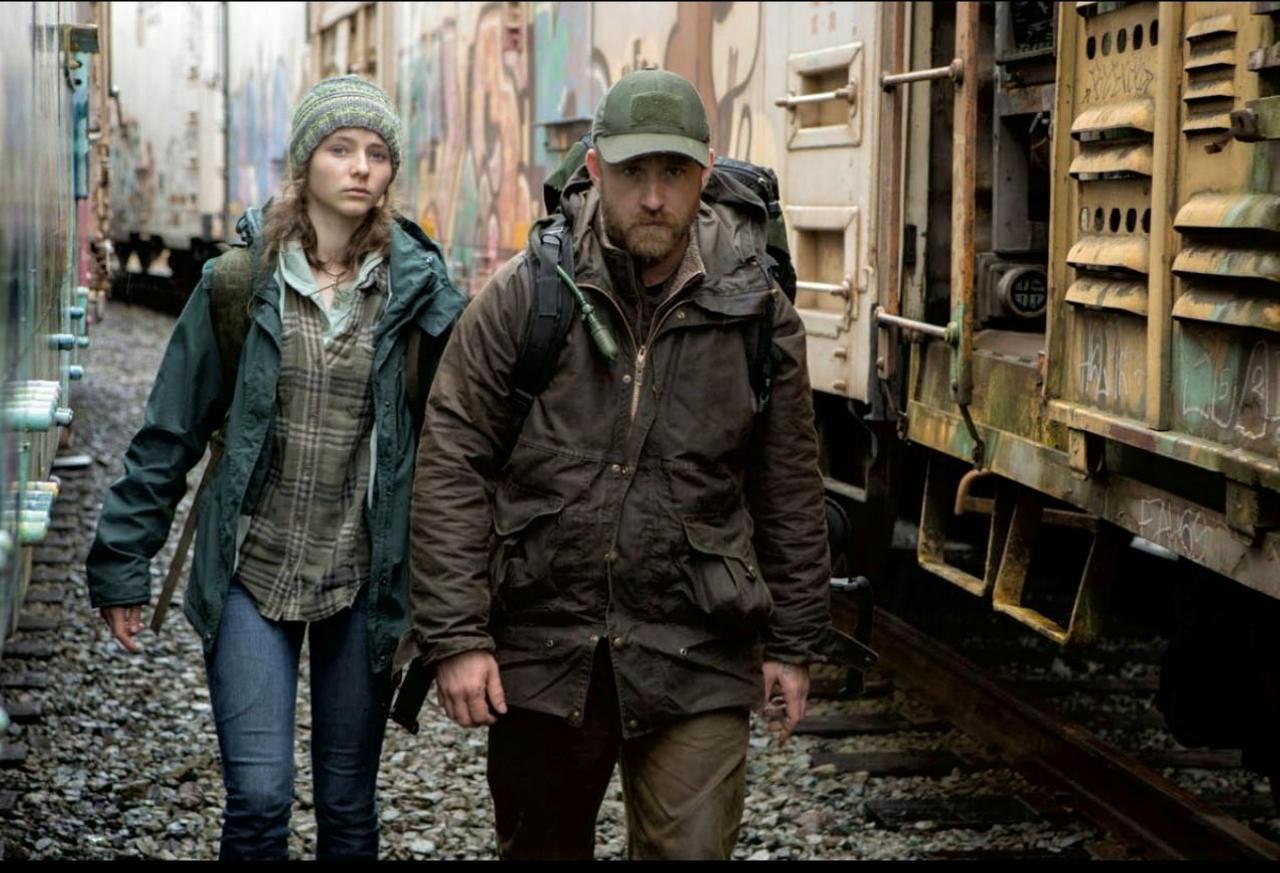
Leave No Trace - McKenzie & Foster.
The piece makes it’s point with the verdant park setting home seeming more attractive
than the mean urban environments and institutions. McKenzie ‘s return to find the
encyclopaedia she learned from sodden and grubby is telling. However the notion of an idealised drop out community is no more convincing here than the Trailer Park in Grapes of Wrath, the farm in Easy Rider (“They do their own thing in their own time”) or the model village in Major Barbara.

OK independent production values, with the performances and contrasted settings strong elements.                                                                                                                                                                                                                                                   
                        
There aren’t too many films about movie editors. The exceptional documentary about
Walter Murch seems to have evaporated. That makes Alex Grigor’s comprehensive study
of Australia's internationally established Jill Bilcock, Dancing the Invisible even more significant.

This one steadily turns out to be a history of Oz production.

After following the traditional path of sixties Australians traveling Europe & India before
finding a footing in the TV boom, “this young blonde thing” Bilcock became part of the
local TV scene. The ambition of Fred Schepsi’s commercials from this period collected
here is impressive. The success of Baz Luhrman’s films made Bilcock an international
name and she clocked up an interesting body of work which isn’t over yet, alternating
Hollywood and Australia.

It’s impressive to see how much footage of her at work the team was able to assemble.
Also interesting to see her output change when she shifts from physical editing to the
computer.
                                                                      
Short films include Emily Avila’s local Fitting which is a model of its kind. The older
woman is fitted for a bra after her mastecomy with the assistance of the inexperienced
sales girl. Utmost delicacy in handling its sensitive subject and professional finish. Dev Patel
from Slumdog Millionaire contributed the professionally finished satire of Home
Shopping
- stay at home wife employs all the items she’s bought from the home shopping
channel on the husband who launches into a “barren womb” harangue. David Oeo’s
Spanish Jaula simulates cell ‘phone coverage.

Cartoons selected from  a couple thousand entries and hived off to a program in a less accessible venue were dominated by Picasso outlines giving birth to offspring with teeth. They did run to the new George Plimpton, Cop Dog the sixth of his “Guard Dog” series with the pooch checking airports looking for drugs, which was agreeably more of the same.

Of course what I saw is only a section of the material on show. On a different schedule I might have come to a different conclusion. If this lot was spread out over the year in a Cinematheque I would certainly have felt more charitably disposed towards it.

Well, it's Sydney Australia and you do the best with what's provided.


Sunday, 22 July 2018

Spanish Masterpiece.
 
Pa negre : Casamajor and Lopez.      

Agustí Villaronga's  2017  Pa negre from Catalonia is a film which opens and closes with acts of extraordinary cruelty - the first physical with the killing of a man, a boy and (more disturbing) a horse and the final an act of psychological violence that can hold it’s own with anything on film.

Set at the end of the Spanish Civil war, the film centres on young, wide eyed Francesc Colomer (first film) whose family is struggling to get by on father Roger Casamajor’s cage bird business and mother Nora Nava's work in a “shitty” local textile mill.  They are recognisably the good guys having supported the losing Republican cause during the conflict, which leaves them at the mercy of local Falangist mayor Sergi Lopez - the film’s most familiar face instantly delineated as a nasty piece of work.

Hold on - it’s not that picture. Lopez will emerge as more justified than dad Casamajor who is constantly urging his son to act on his principles. Advice is coming from all sides here. Alcoholic, pedophile teacher Eduard Fernández (another Spanish name star in a small role) gives a history lesson where he explains that victors should be admired for their triumph and the wealthy for their ability to deploy money. Recognisably part of the film‘s complex, perverse and challenging structure is his repeating “The winners write history” even as we are in the act of watching the losing side putting forward on film their version of events.

Casamajor flees the country to avoid arrest for the murder, advising Navas to take their case to the rich land owners, the Manubens where the husband looks like Francisco Franco and the gross wife is forever gulping treats. Like everyone else, they have a guilty secret but like Fernandez’ example they have the power and viciousness to protect it. Add in Colomer’s half crazy and highly sexed teenage cousin Marina Comas (particularly good) who lost her hand in a grenade explosion and has already rejected the village society with its intrigues, blackmail and lies, planning to cover her escape by setting fires that will engulf it. Her betrayal is the element that sets up the film’s final statement.

Colomer finds that the letter which his father slipped to him on their mass visit to the prison where the shouting inmates are separated from their families by a patrolled bar corridor - like the one in Mikhail Shvejtser’s 1960 Russian Voskreseniye / Resurrection - offers a desperate escape.

The murdered boy’s last word “ Pitorliua” is the name of a bird, given to a local whose photos mother Navas treasures as a reminder of the one member of her generation who stood apart from the brutalisation of the time. His ghost is supposed to haunt the cave in the woods. This figure becomes conflated with the naked boy young Colomer sees washing in the river, turning out to be a tubercular patient who the monks (brief appearance of religion in this scheme) work and half starve in quarantine.

Like the Czech Otakar Vávra’s 1967 Romance pro kridlovku / Romance for a Bugle or Agnieszka Holland & Kasia Adamik’s 2017 Polish Potok / Spoor the young people live surrounded not only by their reality but also the fantasies of the older generations, here notably the society of women alone taking care of the rich Manubens family’s property, with superstitious granny’s tales mixed with the demented accusations of the murdered man’s widow. The hidden keys (prominent in the decor) open the attic door where a mysterious light can be seen. The fantasies become more substantial than the accepted reality of their lives.

Finally the choice for Colomer is between this decayed society which he would enter as an uneducated laborer and the world of privilege made possible by an extraordinary sacrifice by his father. He finds within himself a doubtfully admirable strength.

Putting this on screen is a big ask for any director and Agustí Villaronga, who is highly regarded in his own market, throws himself into a challenge which would inhibit better established film makers. What he produces is brilliant by any standard. The audience makes the same transition from accepting the truths offered by the sympathy generating parents into an uglier adult perception which matches the lesson being offered by the college instructor finally describing the figure who gave up humanity to become a monster.

Some shots are extraordinary - the camera weaving inside the old people’s living space or Navas working on the balcony distant, while the boy tends the cages inside the house, or the truth of the mob violence engulfing it’s original deserted setting. The imagery is startling - the killing the horse, the mob with the boor castrating loop or the bodies being cleared from the garotte in the presence of the family of the condemned man - add Eva Basteiro-Bertoli’s screen filling kiss.

While extraordinarily impressive, the exercise is not a total success. It is undesirably opaque. I’ve seen the film twice with different sets of sub-titles and studied a synopsis (which I regard as suspect) and I’m still not sure that I understand the story. The Spanish speakers I discussed it with were equally confused. The symbolism of the caged birds is labored, like the subtlety free business of the white bread which is not for the boy, even after his shock experience. That is carried on in the Manubens’ table loaded with cake, glaceé fruits and rich hot chocolate. Among so much that is startlingly unfamiliar it’s not re-assuring to find a sub plot purloined from On the Waterfront.

Colomer with white bread
Pa Negre was a big Goya winner and went forward as the Spanish Oscar candidate of it’s year but it didn’t carry off the award and it’s foreign exploitation appears to have been limited. I alerted all the movie goers I know to the Cervantes Institute screening. None of them came. The turnout was less than twenty. 
 
When the festival circuit is pushing so much that it considers to be high art - the equivalent of the major works of gallery art, literature and serious music, Pa Negre has proved indigestible to it. The film goes places where they would prefer not to and shows things that are uncomfortable for it’s suburban, middle class audiences. Pa negre seems headed into the limbo that engulfs genuinely challenging work that doesn’t hide behind the familiar face of art cinema and Marxist politics. It’s unacknowledged existence is an indictment of the whole notion of serious film criticism.


Monday, 4 June 2018

ETERNITY WITH PHIL KARLSON.

Seeing Hell to Eternity again after nearly sixty years was a curious experience, not least because the copy that Channel 9 ran late night (how did that happen?) was considerably longer than the one I’d seen in 1960.

 Two hours and eleven minutes was a hopelessly ambitious length for a black and white B movie that was going to end up on bottom halves of programs.

This one was one of the US action movies of the day which had their after-life in flea pit re-issues. I thought I was their only fan in the world till I made it out of Australia and found the crumbling movie palaces at the Central Railway end of Sydney had a counterpart in London’s Biograph and Tolmer, Dublin’s Ballsbridge Ritz, 42nd. Street’s grindhouses or Paris’ Studio Actions and Le Mambo where the interval curtain had local trader decals like a turn of the century music hall. As with the Hong Kong Films of the Seventies, their re-cycling double feature programming encouraged repeat viewing and hammered the material into memory.

The product had curious limits. Hoppy and Roy Rogers were too juvenile. The newly accessible European skinflicks were too adult. One distributor described the ideal product as "a colour Western with a G Certificate" - to which were added the Black and White Crime, Monster & War movies. I remember the editor of Films and Filming saying his writers watched too many films. These were the ones he meant.

The hunt pack of Films & Filming writers and the Paris cinéphiles placed these at the center of their movie going experience. More conversations turned to them than James Bond, Tom Jones, l’Aventura and the London Film Festival. Instead of Taste of Honey, La Chinoise and The Man Who Shot Liberty Valance we soppped up the exploits of Audie Murphy, Rory Calhoun, Joel McCrea, Dan Duryea, Sterling Hayden and of course Randolph Scott. A feature performers like Allan Ladd, Glenn Ford and Richard Widmark were welcome visitors. Women didn’t have the same profile, with Maria Montez and Maureen O’Hara past their zenith and Yvonne De Carlo and Shelley Winters kind of peripheral. Julie London maybe.

Bob Stevens' Never Love a Stranger: Milan & Barrymore


The notion of authorship had a good innings though, showing up no no directors like Ray Nazzarro, Lee Sholem,  Herman Strock or Joe Pevney - who was, like Gerd Oswald, better on TV. The best work among the thousand or so contenders was near to always attached to a regular-suspect director. Along with the western Holy Trinity of Anthony Mann, Delmer Daves and John Sturges, Andre de Toth and later Bud Boetticher generated the Randolph Scotts, Jack Arnold did No Name on the Bullet and It Came from Outer Space, Maury Dexter Woman Hunt and House of the Damned, Joseph H. Lewis Lady Without a Passport, The Big Combo and Terror in a Texas Town, Bob Stevens The Big Caper and Never Love a Stranger, Hugo Fregonese Apache Drums, The Raid and Black Tuesday. Don Siegel followed Invasion of the Body Snatchers with Baby Face Nelson and The Line Up and Sam Fuller, demoted from his Fox features, contributed Underworld USA, The Crimson Kimono and Shock Corridor to match Jacques Touneur’s Night of the Demon and Wichita. Killer’s Kiss and The Killing came from a young still photographer named Stanley Kubric.

Which brings us to Phil Karlson not honored in his own country or any place else until it was all over and he got to share a book with Joe Lewis. Karlson clambered up the ranks of B movie gophers in the thirties emerging as a director with A Wave, a WAC and a Marine in 1944. Not all of the poverty striken second features he had his name on were masterpieces but a determined viewer would have spotted that his entries in the Shadow series (Behind the Mask 1944) and the Charlie Chans (his very noir The Shanghai Cobra 1945) outclassed their running mates and by 1949 his Down Memory Lane compilation from Mack Sennet footage, The Big Cat in subdued Technicolor and Iroquois Trail cannibalising the Randolph Scott Last of the Mohicans all showed him pulling away from the pack. Columbia started giving him more ambitious product which he handled professionally. Valentino imitator Anthony Dexter and Tony Quinn in The Brigand was fun.

However our man found his niche in the fifties crime movie. 99 River Street, Kansas City
Confidential and Tight Spot (Edward G. Robinson, Ginger Rogers and Brian Keith) led to The Phenix City Story, Phil Karlson’s signature work. Filmed, they told us, under police protection it was an extraordinarily violent, extraordinarily plausible account of murder and corruption the proximity of an army camp brought to the community. Richard Kiley minus his hair piece and John MacIntire, in the real suit of the mob killing victim, headed up an excellent cast. This was a film with idea content and that didn’t become buried in the action.

Mixed in with some TV work, the excellent Gunman’s Walk and The Scarface Mob (The
Untouchables
pilot) followed, before Hell To Eternity, not Karlson’s most expensive project but his most thematically ambitious.

When they decided to film the story of Guy Gabaldon, WW2’s "the Pied Piper of Saipan", the backers probably expected they would get something like To Hell and Back. The State Department was urging Hollywood to play nice with their new Japanese allies and a few films like John Sturges’ great Bad Day at Black Rock or Robert Pirosh’ Go For Broke were already in circulation.

Hunter, Vic Damone, Janssen & Galbadon
Gabaldon, unlike star Jeffrey Hunter fresh from playing Jesus in Nick Ray’s abominable King of Kings, was Hispanic. He had been fostered by a Japanese family though not as extensively as the film suggests. He was not as fluent in Japanese either and not rejected for military service for a perforated eardrum. That was something they borrowed from the WW1 war record of co-star Sessue Hayakawa.

The film is a fictionalised version of Galbadon’s WW2 exploits preserving the shape that made them notable. Steered away from delinquency by his school’s Japanese sports coach, the character finds himself in the cross hairs when America enters WW2. An effective scene has Hunter at the drive-in lunch counter with his adoptive brother’s Japanese fiancée. One of the diners, who has just heard the broadcast of the Pearl Harbour attack, abuses the girl starting a fight but the man’s friend has a clearer view of events and warns Hunter “Get that girl off the streets!”

The Karlson film spoke out on racism in WW2 America quite explicitly in a touching scene of the Japanese family rounded up by the military from their tract home for “a concentration camp” and querying why German and Italian Americans are not being collected in the same way.

There is a brief scene in a minimally detailed Manazar, the camp subject to a more thorough examination in Alan Parker’s 1990 Come See the Paradise. At this point, the film shifts into more traditional ground with scenes of marine training under Sgt. David Janssen. After some strenuous R&R in the Islands, the Americans land at Saipan overcoming Japanese resistance and witnessing civilians flinging themselves off the cliffs after hearing of the barbarism of the invaders. (this is detailed in Ken Burns brilliant  documentary The War) Galbardon uses his skills to negotiate the bloodless surrender of more than a thousand of the already defeated enemy.

Hell to Eternity can’t avoid the defects of its schizoid form. The two scenes which stuck
Owens : Hell to Eternity
in  my memory are more useful to trailer makers than to the film’s idea content. We get War Correspondent Patricia Owen’s stripping at the drunken party. Though Japanese dancer Reiko Sato, whose act precipitates the scene is the more skillful performer, it is Owens who registers, partly because of the way she is presented as buttoned up and severe, with references to “the iron petticoat.”  The scene still carries its erotic charge. It somehow gets disproportionate representation in the advertising.

In her relatively short career, Owens had quite a profile in Grindhouse repertory with this film, The Fly and Sturges’ The Law & Jake Wade.

The other vivid memory episode was Janssen’s last scene, with its propulsive trackings and savagery. It is more connected to the film’s main drive; Galbaldon / Hunter’s vacillating in his perception of the Japanese as a civilized nurturing culture and bloody-handed aggressors.
 
Karlson manages all the action material effectively, notably the amphibian landings, his limited budget running to a few pieces of war machinery and a generous number of uniformed extras, presumably the contribution of the 3rd Marine Division from Okinawa, who collaborated on this film. I’m told military detail is scrupulous. By contrast, the Corps had refused aid to Stuart Heisler's Beachhead which was perceived as grisly enough to discourage recruiting

Hell to Eternity sneaks in imaginative touches - reflecting the naval barrage on General Hayakawa’s field glasses, showing the body strewn aftermath of battle in total silence or having the performers who played the family in the early scene re-appear as suicidal Japanese Islanders. This last has been blunted in post-production by superimposing their earlier appearance on the scene which played more effectively without it. More daring, Hayakawa does his big speech to the troops in Japanese without translation - remarkably impressive. This gets around the big ask of making the effect of his oration credible to non speakers. Compare betrayed Yul Brynner angrily dictating his memo in Russian in 1959’s The Journey.

Hayakawa was coming to the end of an international star career stretching back to 1914, of which regrettably little is accessible. His performance outclasses the film’s other elements, despite the limitations of script and staging, which put him at the mercy of  carbine waving Jeffrey Hunter (“Shot by a lousy P.F.C. There’s no honor and glory in that”)

Hell to Eternity : Hayakawa and Hunter
Hayakawa is right on top of his game here, his shaded performance evoking an anachronistic notion of military valour, in conflict with the brutality of the situation - the banzai frenzy he has generated in his troops. His part was the major casualty of the condensation which, while it may even have improved the film, robbed it of this richest ingredient.

Sessue Hayakawa matinee idol       
Sessue Hayakawa in Hell to Eternity
Also notable is the only sound appearance of Hayakawa’s wife and silent movie co-star Tsuru Aoki, who registers vividly as Mother Une, generating motivation that the writing has trouble matching. 

Outside of a dreary score, the production values and Karlson’s deployment of them have professional excellence. Notice the speedy wind up, character-istic of the best of the cycle - films like The Big Heat or Black Tuesday
 
Karlson at very least understood "what the film was about,"defying that denigration which Hollywood personnel apply to colleagues they don’t respect. Touches like the one shot of the stateside bar where men are swilling their drinks under the realisation of the war situation or the ambivalence allowed Hayakawa are not what you expect from the thick ear environment of Allied Artists making a grindhouse feature.
 
Karlson had more ambitious work ahead of him, films with Robert Mitchum and Elvis Presley. His endearingly trashy The Silencers re-cycled the backwards shooting gun from The Brigand. His The Young Doctors was a mainstream feature anyone would have been proud of and Walking Tall made him a fortune.

Now we can see Hell To Eternity in there with Cornel Wilde’s Beach Red, as a step towards the greater sophistication in war films like Speilberg’s Saving Private Ryan or the Clint Eastwood Letters from Iwo Jima with which Eternity shares a number of elements. It puts earlier Major Studio efforts like Battle Cry and Between Heaven and Hell in the shade, despite their prestige and more substantial resources. This one bookmarks a whole class of film making that has never been properly appreciated.

Eventually the stars would retire with only Lee Van Cleef managing the transition by becoming the Italians’ Mr. Ugly. For a while there Steve Reeves and Franco Nero filled the ranks of the fallen but the cowboys were gradually replaced by Shaolin Masters and Karate Kids. The theatres fell victim to the once despised exploitation films. I remember traveling out to Islington, newly renamed the Screen on the Green, to see Girl on a Motorcycle in what had till recently been an action double bill house. One of the old regulars was sitting in the row behind me and muttering to himself “Sex, sex, sex. It’s all sex now!” Comes the scene where Marianne Faithful and Alain Delon get it on and, as they climax and the image freezes, he looked up and observed “All over now.” He was right. I was so sorry to see it go.


Sunday, 31 December 2017

THE YEAR 2017.

Yes, I’m still doing it. After another year of movie going I notice that the fringe operations are edging out the multiplexes as the major source, though whether you can count as fringe the Asian movies in a Chinese owned city center complex is speculative.


The films which impressed me when I saw them for the first time this year in some sort of order were LA LA LAND (Dominic Chazelle just getting into the new year and nobody fiddled the cards for this announcement), KONO SEKAI NO KATASUMI NI (In This Corner of the World, Sunao Katabuchi’s Hiroshima manga), THE VIETNAM WAR (another great Ken Burns & Lynn Novack TV series),  AUS DEM  NICHTS  (In the Fade - Fatih Akin with Diane Kruger), SILENCE (reverence from Martin Scorsese), DUNKIRK (Christopher Nolan in 70mm.), The YOUNG POPE (Paolo Sorrentino TV), La TENEREZZA (Tenderness - top flight Gianni Amelio), BACALAUREAT (Graduation - Cristian Mungiu, Rumanian), WONDER WOMAN (Patty Jenkins pick of the strip catoons) WO BU SHI PAN JINLIAN (I Am Not Madame Bovary - Xiaogang Feng), The Edge of Seventeen (Kelly Fremon Craig), Zhan lang II (Wolf Warrior II /Jing Wu), Felices 140 (Happy 140 - Gracia Querejeta), Incendies (Denis Villeneuve), Churchill (Jonathan Teplitzky) Wind River (Taylor Sheridan), Terra madre (Alessandro Blasetti 1931 ), El ciudadano ilustre (The Distinguished Citizen - Gastón Duprat, Mariano Cohn, Argentia), Trinadtsat (The Thirteen - Mikhail Romm 1936), Dvoryanskoe gnezdo (A Nest of Gentry - Andrey Konchalovskiy 1969), Patriots Day (Peter Berg), Fang hua (Youth - Xiaogang Feng, El destierro (The Exile - Arturo Ruiz Serrano), Bahubali 2: The Conclusion 

Bahubali : Prabhas
(S.S. Rajamouli), Que Dios nos pardone (May God Save Us -  Rodrigo Sorogoyen),  Les premiers les derniers (The First, the Last  - Bouli Lanners), Wilson (Craig Johnson), Capitan Kóblic (Sebastián Borensztein), Tarde para la ira (The Fury of a Patient Man - Raúl Arévalo), L’intrusa (The Intrusion - Leonardo di Costanzo), Dangal  (Nitesh Tiwari),  Sanpo suru shinryakusha (Before We Vanish / The Strolling Invaders - Kiyoshi Kurosawa), Plan de fuga (Escape Plan - Iñaki Dorronsoro), Visages, villages  (Faces Places - JR, Agnès Varda), Denial (Mick Jackson), Blade Runner 2049 (Denis Villeneuve again), Naples '44 (Francesco Patierno), Mugen no jûnin (Blade of the Immortal - Takashi Miike), Lady Macbeth (William Oldroyd), Railroad Tigers (Ding Sheng), Khaneye dokhtar (The Girl's House - Shahram Shah Hosseini Iran), Cerca de tu casa  (At Your Doorstep - Eduard Cortés), Otôto (About Her Brother/ Younger Brother - Yôji Yamada). 

Tenerezza - Carpentieri & Germano.
The Spanish and Italian film events made a disproportionate contribution (thank you). Nearly as many Hispanic as Hollywood films listed. A few people are getting to be repeat offenders on these lists - notably Woody Harrelson, Feng Xiaogang and Ricardo Darin. Add in the novelty of  Hun Jang’s Korean Taeksi Woonjunsa (A Taxi Driver) and Saman Moghadam’s surprising Iranian Sperm Whale 2 :  Roya's Selection which I seem to be constantly referencing.

A lot of material admired in other places will take years to get to me here. Look at old overseas ten best lists and notice how many no shows there are. Also, since the theaters stopped listing their programs in the press and apathy and lack of support dismantled the enthusiast groups, word of mouth network, it’s easier to miss the oddities that do make it.

 
WO BU SHI PAN JINLIAN : I Am Not Madam Bovary : Fang Bingbing.

Tuesday, 7 November 2017

ITALIAN FILM FESTIVAL 2017  - Part 2.

 Opening night at the Italian Film Festival you scored Francesco Amato's Lasciati andare/Let Yourself Go which, like too many film festival selections, must have been chosen because it wouldn't scare away paying customers. This opened for an extended run the week after.

It is a conventional comedy where it’s a surprise to find current face of the Italian serious film Tony Servillo doing Woody Allen. He plays a Jewish psychoanalyst who is too mean to pay for a divorce from the appealing wife still doing his laundry and living in the next flat in the ghetto block where Tony is infuriated by the Observant neighbour who leaves the top floor lift door open on Sundays to avoid breaking shabbat.


The patients from Tony's practice keep on turning up in the film’s plot developments. They include Giacomo, of the great Aldo, Giacomo and Giovanni team, who dates the wife and is more in his element.

Tony’s told by his doctor to get into shape or he’ll get diabetes, listing the consequences, and that bringing his mum’s exercise bike up from the cellar won’t help. He won’t stick with that the way he would with a gym membership. That’s using psychology on the shrink.

In the gym, Tony collides with sex pot Verónica Echegui running her jazzercise class in her spandex pants and when she hides from the owner’s jealous wife in the steam room with Tony, she convinces him he needs her as a personal trainer - predictable jokes about him running and working out with her as he gradually gets into shape.

Her whacked out sex life intrudes, with her black son setting fires, including one on
Tony’s jacket. 
She is working Tony as part of the scheme where her psycho prisoner boyfriend Luca Marinelli wants to be hypnotised into remembering where he put the jewel store robbery loot. We've forgotten about him pacing out and burying this at the start of the film. When Tony finally gets him on the couch the piece moves deeper into knockabout. The session puts pistol waving side kick Vincenzo Nemolato to sleep and recovering the loot involves dropping an owl cage on the hapless Slav's head.

The handling is brisk and the bright colour scheme attractive. Mixing Jewish jokes, shrink jokes and slapstick crook comedy is occasionally amusing but we’ve been there before and might have hoped they’d come up with a more substantial vehicle for Servillo.

Simone Godano figured the personality swap idea could stand another go round as her first movie Moglie e marito/Wife & Husband. I wasn’t so sure. To start with macho Pierfrancesco Favino (Suburra) and elegant Kasia Smutniak (Perfetti Sconosciuti) seem unlikely contenders for a gender swap but that’s the thing that drives the film. Inner Favino having to come to terms with kissing outer Favino with three days growth of beard is in the same dodgy area as Hal Roach’s old Turnabout  but they embrace the possibilities and the leads enjoying making out is one of the funniest parts of the film.


Moglie e marito - Smutniak e Favino 
He’s a scientist trying to produce a machine which will transfer memories from one individual to another and she’s a sleek wannabe TV personality. Their marriage is on the rocks when his experiment swaps them over. There is the now familiar uneasy comedy of her acting butch and him fluttery but they do manage to get laughs out of inner Favino sitting with legs apart revealing his panties on her TV show and moving into startled Valerio Aprea’s flat while Kasia is outraged that he is putting junk food into her trim body and letting the baby breast feed after she had weaned it.

Best glossy European production values put the characters into plausible home, laboratory and TV industry settings. The piece gains a bit more traction when the pair have to use their old skill sets to sort out the problems they have caused but the ending when both have to articulate what they’ll miss if the transfer is reversed is actually quite touching.


Amori che non sanno stare al mondo/Stories of Love That Cannot Belong to This World is intensely female, like writer-director Francesca Comencini’s 2009 Lo Spazio bianco, so much so that a bloke viewer is likely to feel uncomfortably like an eavesdropper.

We kick off with thirties-ish Lucia Mascino waking up and immediately sending of needy texts to her ex-lover, who says he’d rather be put to the rack that resume their association. After chatting with her female neighbours, each with their own relationship dramas, needing a fifty Euro recharge for her smart ‘phone is a major crisis.

The film stays with the intensely irritating Mascino, pulling of the considerable feat of enlisting the audience to her point of view.

We see her as a disruptive speaker on a panel with white fleck bearded Professor Thomas Trabacchi. Her interruptions get her into his bed for a protracted relationship where they move in together. After make outs and inexplicable Black & white inserts, they reach the point where she wants to discuss feelings and he wants to rest up for the paper he has to complete the next day.  His lack of commitment (“I will not be prisoner of a dream I don’t share”) triggers their break up “Take a suitcase. It’s humiliating to be left by a man with a back pack.”

The separation is rough on Mascino despite the comforting of her friends and meetings in the university wash room where women compare experiences. However, Mascino finds consolation in an encounter with a glamorous pole dancer which comes with some striking naked lesbian love making.

Trabacchi meanwhile has paired with an appealing girl student who makes it clear she wants a ring on her finger. Trabacchi pictures Mascino criticing his conduct. News of the marriage gets back to Mascino who faints but rallies.

The former lovers later have a brief meeting and discuss the direction of their lives. We are given the impression that Mascino has the firmer grip on coming realities.

Some academic background, discussions of female orgasm and lots of skin pore close close-ups in wide screen are part of the film’s intense scrutiny. This one takes a lot of concentration. It’s not for everyone but I would imagine it will enthuse an audience that will identify with its female protagonist.

Daniele Vicari’s Sole, cuore, amore and Sergio Castellito’s Fortunata - a couple of  grim accounts of struggling working class mothers weren’t equal to their ambitions, though surprisingly Leonardi di Constanza’s L’intrusa without name stars and technicians covered the same area remarkably well. 


Fortunata : Trinka  


Director Sergio Castellitto was determined to jam everything into Fortunata - mother love, abusive husband, police brutality, kids’ birthday parties, Chairman Mao, drug use, burka women, racial slurs, loan sharks, a raunchy make out, a Chinese women’s synchronised tai chi routine in the rain and of course, being an Italian film, ‘vergogna’.


Castellito is an actor and his first loyalty is to his players who get to give bravura performances. Bleach-blonded Jasmine Trinca does the whole Anna Magnani thing as the beautician mother of young Nicole Centanni trying to keep custody despite the rough handling she gets from cop husband Edoardo Pesce. She also has to work it out with immigrant lover Tattooist Alessandro Borghi, who is helping build the salon where she can do heads without having to trundle all over the city.

Borghi’s life is further complicated by his dotty mother who no longer recognises him, a nice raddled turn by Hanna Schygulla. Her  presence prompts several nice visual touches. Borghi has the image of her, young and glamorous, inked on his shoulder and her floating umbrella is good movie short hand.  Some hope emerges when the child psychologist Centanni is referred to for spitting turns out to be simpatico Stefano Accorsi. His job is driving him spare. Accorsi's description of tracking down his deadbeat dad in Africa is one of the film’s highlights.

The film is effectively located in the urban fringe. Trinca trying to find a ‘phone booking on the outlying high rise intercom on the wrong side of the ring road gets asked if she gives massages.  The hairdressing salon with the blue neon sign reading “Lucky” is working it too hard however.

The film is a glum soaper not really lifted by its ambitions and strong cast. Castellitto’s best contribution to the Italian Film Festival has been showing up dubbed up in that nice Lavazza commercial. “In life there is always more to taste.”

Vicari’s 2012 Diaz - Don’t Clean Up This Blood! (title in English) is so imposing that I homed in on his new Sole, cuore, amore / Sun, Heart, Love with some enthusiasm. While it has strong characterisations, convincing locations in the Ostia region and the significant subject of the working poor, I came away disappointed.

The film is unrelievedly grim and it is undermined by the rather precious device of cross cutting Isabella Ragonese’s hard lot with the dance performances of her downstairs neighbour Eva Grieco, with their brass instrument accompaniment blaring on the track of both.

Ragonese is a mother of four who finds herself working as a waitress two hours away from her home, getting up at four thirty in the morning, catching an unreliable bus and train with the striking shot of the passengers finishing their trip on foot at dawn to make the point. She finds herself being docked by boss Marzio Romano Falcione for late arrivals. One of the film’s strengths is that both she and the film see his point of view, having hired her on the basis that she would work his seven day week and having to placate his dissatisfied ex cashier wife and expect the same standard of competence from his Arab student counter hand.  Husband Francesco Montanari looks after the kids and provides a spiff to smoke on the balcony of their sea on both sides flat but Ragonese is too exhausted to get involved in sex.


Sole, cuore, amore - Ragonese.
The pressure on Ragonese mounts plausibly but not all that involvingly, piling grief upon grief. Comes the finale and she’s been told to get medical treatment but finds herself sitting on the subway bench as her trains pull out. Throw in a lesbian shower scene and a little girl singing "Sole, cuore, amore" in the cafe.

On the other hand mature director Leonardo di Costanzo's L'intrusa/The Intruder is an agreeable surprise. It comes with a load of social indignation and is the kind of project subsidy hungry film makers turned out with infrequent success in the eighties.


 Di Costanzo had a career in documentaries, did an episode in a portmanteau film to which Jean Luc Goddard also contributed and has made one other dramatic feature. His script is co-authored with Bruno Oliviero, the director of Silvio Orlandi's 2012 La variabile umana. The approach here is to dispense with sculptured lighting and star performances in a subject that might have made a main stream dramatic feature.

Valentina Vannino, the wife of an arrested Camorra crime syndicate murder suspect, is given shelter in the hut on the scruffy suburban waste land that severe looking organiser Raffaella Giordano uses for a kids playground. She is setting up a Festa, one of the few activities which brighten the drab Neapolitan working class area. Music, a papier maché lizard and a ride on mechanical man made out of bike parts are in preparation.

The parents and school authorities object to Vannino who they associate with a brutal killing that has left one of the children mute after seeing her father beaten to death in front of her. Giordano protests that her project is "per tutti bambini" but there is an incident in which Vannino responds in character and the whole project is jeopardised.

Full of telling realistic detail - the bike repair shop guy who understands how to involve the withdrawn child, the visits of the Camorra wives, Vannino's second thoughts about make-up, the severed human hand that the kids spit at. The Festa makes a nice (ironic) climax. What might have been big dramatic scenes - finding the intruder in the locked kitchen, the meeting between the two little girls or the final understanding of the consequences are not shown. Instead we get loosely framed shots and subdued colour, not unlike news coverage. Mixing between source music and the play-out is about as interventionist as di Costanzo will go.  The staging with families overlooking the shared ground also sometimes resembles The Wire.

This one is well worth a viewing.

Giuseppe Piccioni penetrates the gumnut curtain more often than most Italian film makers and those movies have been consistently engaging - 1996’s Cuore al verde/Penniless Hearts, 2001’s Luce dei miei occhi/Light of My Eyes, 2004’s  La Vita che vorrei/The Life I Want  and 2009’s Giulia non esce la sera/Giulia Doesn't Date at Night.

His new Questi giorni / These Days is a departure from them. The only one of his regular performers to show is a now mature Margarita Buy who acquits herself impressively as a middle aged mother, becoming a hairdresser, her ambitions sacrificed to raise daughter Maria Roveran. She’s highly critical of her girl’s do.

The plot centers on four young women about to enter adult life. Roveran is diagnosed with a life threatening disease (excuse for one of the film’s boob shots). Orchestra violinist Caterina Le Caselle has become pregnant. Laura Adriani’s love life with Filippo Timi (La doppia ora) is stressful and dissatisfied Marta Gastini (also in
Moglie e marito) has accepted a waitressing spot in Belgrade. The early stages of the film establishing the leads are uninvolving as the audience struggles to remember which back story goes with which unlined face.

However, when Gastini decides to drive to her new Serbian job, the others join her and the piece turns into an engaging Italian Road Trip movie. The girls with their pre-occupations and lack of experience become distinct characters. They encounter a group of English-speaking boys who take an interest, lending them a tent and taking them canoeing at the camp site. One tries to link up with Roveran - shot of him awkwardly sharing the back seat in the car. Gastini takes a dim view of that, sends him for coffee, dumps his back pack and drives off.

When they get to her drab looking Serbian destination they share the flat of her severe friend Mina Djukic, part of a group restoring a Belgrade cinema - which shows The Case of the Missing Switchboard Operator over the dance floor. The backpacker is there and lets it be known that his experiences with the girls screwed up his vacation and he is looking elsewhere now - telling small scene.

Finally, a dash to the emergency room unites the friends in a way that makes the film rewarding. It has an uncharacteristic natural feel and reliance on close-ups of fresh featured young women which may (or may not) draw on improvisation

Effective desaturated scope images. The great Sergio Rubini (La bionda) is down to a walk-on.

 The political thriller is one of the best traditions in European film making - Cayatte’s Nous sommes tous des Assassins (France, 1952) Autant-Lara’s Tu ne tueras point (France, 1961), Costa Gavras’ Z (France, 1969), a whole swathe of the work of Gian-Maria Volonte, Bellocchio’s Buongiorno, notte  (Italy, 2003)  and Diaz, Don’t Clean Up This Blood.

For Annarita Zambrano to move into this company with her first feature Dopo la guerra/After the War (Italy, 2017) with a first time writer and featuring young Charlotte Cétaire in her debut role is a big ask and it’s impressive to see how far they get.

Dopo la guerra - Battison & Cétaire 
The opening is riveting, with a university professor leaving an angry 2002 student meeting, only to be gunned down. The assassin claims to be from The New Armed Faction for the Revolution, a long dormant Italian movement from the “Years of Lead” eighties political turmoil.

This impacts on Giuseppe Battison as one of the movement’s former leaders now sheltering in France under a Mitterand era amnesty. One of his fellow exiles has already been repatriated to face jail in his native Italy and Battison goes on the run, hiding out in a dilapidated Contis des Bains farm with his daughter Cétaire who was about to compete in her school sports contest and sit for her bac.

She sees her life destroyed, particularly when the striking Marilyne Canto arrives to do an interview, which will counter act a damning cover story in L’Express.  The journalist lets slip dad's plan to shift to Nicaragua.

Parallel with Battison’s flight, his sister, the still great looking Barbora Bobulova (impressive in Paolo Franchi’s La Spettatrice/The Spectator and Ferzan Ozpetek’s Cuore sacro/Sacred Heart) finds their association with a terrorist brother she hasn’t seen for twenty years jeopardises her position as a lecturer on the work of Dante, her husband’s election as chief magistrate and the safety of her mother Elisabetta Piccolomini through whose window a brick with the word “assassin” has been heaved. Bobulova discovers that her mother has been in secret contact, cherishing hidden photos of Cétaire.

The weight of the film falls on Battison whose character is given exceptional depth. He killed the judge who had condemned his associates in front of the man’s eight year old child only after he had seen his own brother shot down “sous mes yeux” by police after he had surrendered his weapon. He views the only outcome of his situation being the amnesty of his movement after their war - something the Italian government will never give. Battison has the telling story about meeting his former school mate while on the run and the man admiring his veins, having become a junkie, a casualty of a regime which would rather see his generation destroyed by dope than given responsibility.

Battison speaking French, (this is a French movie despite its Italian star, subject and place in an Italian Film Festival) is stretched to his limits. The amiable fat man comic of his earlier films did manage an effective serious part, dominating Paolo Genovese’s recent Perfetti sconosciuti/Perfect Strangers but this role would have challenged Volonte at his peak. The ending we are given fails to exploit the possibilities the film has established.

Zambrano’s handling is more at ease with film form, spacing the dialogue with effective locating footage - Bobulova in the street with graffiti like that of the opening, the glimpsed night time fair, Cétaire caressing the kittens in the barn or cycling through the striped shadows the line of trees throw on the road.

With its possibly inevitable shortcomings Doppo la guerra is still an imposing piece of work. It should be seen.

This makes a revealing comparison with Sidney Lumet’s dominant pre-occupation, the grown children of the second half Twentieth Century left. Think Daniel, Running on Empty or Garbo Talks or indeed Ricardo Darin in Kamchatka.

Fabio Grassadonia and  Antonio Piazza’s Sicilian Ghost Story is something new – a genuinely scary movie derived from the case history of a Mafia murder, filmed in an unfamiliar style that fluctuates between realism and fantasy. Romeo and Juliet get mixed in with Dante and a few more high culture references.  - sound like your total festival movie? Well it is but it overcomes that handicap.

We start with a scene of Sicilian school children on their way home with young Julia Jedlikowska following class mate Gaetano Fernandez off the path only to be attacked by a menacing dog whom he distracts with a half sandwich and his back pack. The two go off on the motor scooter he’s under the age to ride to see his steeplechase horse and they have their first kiss. In the background we spot a giant dam and a police car headed towards Fernandez’ house. The girl comes back after dark and Vincenzo Amato her father, while clearly angry, embraces her.

The boy vanishes from the classroom and everybody avoids the subject. There’s no sympathy in either house. The boy’s grand parents won’t talk to her and her mean Swiss mum spends her time in the house sauna and serving dad cold pasta meals from the fridge.

Turns out that Fernandez’ unseen father is a super grass and his former polizia associates have kidnapped his son to pressure him into silence. Both children lose their grip on reality under the pressure of his captivity and her efforts to find out where he’s being held. The film’s most striking innovation is a dream sequence that we assume is one character’s when it proves to be the other's.

Evidence of a decayed society is everywhere. The pet owl fed on the poisoned mice in the barn is one of the film’s nicest double duty bits of business. There are a couple of striking wide angle distorted tracking shots and it is all filmed in a disorienting style with cuts to objects too large in the frame, exaggerated sounds and confusing digressions. This contributes to the considerable suspense.

If the film has a fault, it is the clashing style of the sunny ending. Of the young players making their first film, friend Corinne Musallari sending coded messages by flashlight across the dark hillside village makes the most impression.

Feel good pieces don’t leave you feeling better than Gianluca Ansanelli's bright coloured scenics packed comedy Troppo Napoletano/From Naples With Love.

When his wedding singer dad is killed in a crowd surfing accident (they distracted the audience by announcing the prawn dish), troubled fat kid Gennaro Guazzo is assumed to have made a suicide attempt after school janitor finds him mounting the balcony.  Actually he was trying to get a better look at the girl classmate he has the hots for. Guazzo gets put into therapy with Dottore Luigi Esposito who explains that the kid’s entire extended family can’t attend the sessions. Mum, lush red head Serena Rossi, and an aunt clean his kitchen while he talks to the kid instead.

Troppo Napoletano - Rossi, Guazzo & Esposito
Bonding with Luigi over Papaya gelato, Guazzo tries to set the shrink up as a match for his widowed mother, sabotaging a succession of comic suitors. However, he finds that the object of his pubescent affections is the daughter of an ex-soap star whose drama class mum attends and who looks like pairing with her.

Determinedly Neapolitan, with Guazzo walking through the open air mercato with Rossi , taking the object of his affections on the tour of the church crypt and getting the animated history lesson about Greater Napoli. Lots of nice views of the Bay. The shot of the girl sitting alone on the beach is a great piece of movie punctuation.

Throw in a load of broad comedy and appealing characters, Guazzi’s fantasies (he pictures taking out a mortgage by plonking his piggy bank on the manager’s table), a couple of great musical numbers - Rossi doing her “La Spagnola” act that the neighbours crowd in to see - and the final Saturday Night Fever kids recital, and the fact that the film is a grotesque rendition of adolescence fades away.

Questione di Karma / It’s All About Karma
looked a likely item coming from Edoardo Maria Falcone of 2015’s Se Dio Vuole/God Willing fame and featuring popular comic Fabio De Luigi (Il peggior settimana /Natale della mia vita and the Aspirante vedovo re-make) and Elio Germani an establish star (also in Ternderness) and it’s cast and presentation can’t be faulted. However all this production value is wrapped around a formulaic script played for predictable laughs.

We kick off with the heir to the coloured pencil factory idolising his dad who jumped out of the top storey window of their home. Grown to be bearded de Luigi who is on the point of having his inheritance taken away by his step father and sister Isabella Ragonese (transformed from Sole, cuore, amore). His Budhist studies send de Luigi off to meet reclusive author Phillipe Le Roy in his alpine retreat.  The sage is more interested in roast potatoes than enlightening our hero on re-incarnation.

Germano shows up as a conman who manages to convince de Luigi that he is his reborn father and in the usual feel good interaction the pair give each other’s lives a new impetus. It takes all the cast’s charm and the best technical finish to make this one go the distance. De Luigi’s transformation from earnest slacker to hard nosed business man is hard to take as a happy ending though the misleading climax of Germani’s plot is agreeable.

Massimiliano Bruno’s Ignorance is Bliss/Beata Ignoranza an attempt to recycle God Willing’s teaming of Marco Giallini and Alessandro Gassman, works out better, despite a change of direction half way through. We start off with teacher Giallini, who confiscates his kids' cell 'phones at the beginning of his lesson, discovering his old rival Gassman has been appointed to his school with a philosophy of ignoring paperwork because everything they need is on the Net. They nearly come to blows to the delight of their students whose video of the confrontation goes viral.

We've seen the menace of cell 'phones played out with Giallini before  in Perfetti sconosciuti.  Complications ensue when their shared daughter (yes, we remember Les Compères) arrives pregnant with her "quirky" film crew to have them filmed switching their approaches for her TV documentary. This element gets lost as we explore the leads' character shortcomings - particularly in their dealings with women. The appealing Valeria Bilello is particularly badly used.
  
There are a few attempts to open up the form, as with the early scenes of turning to the audience or Carolina Crescentini's answering back from the mortuary photo, but mainly the piece coasts on the opposition of the two leads backed by skilled players and brisk film making.

Silvio Soldini has been off our radar most of the time since his 2007 Giorni e nuvole / Days and Clouds and we’ve seen regrettably little of his star, the immensely appealing Valeria Golino  - Rain Man 1988, Giulia non esce la sera / Giulia Doesn't Date at Night 2009 among some remarkable items.
Questione di Karma : Germano & de Luigi at Trevi Fountain
Signora Golino is in top form in the new Il colore nascosto delle cose / Emma playing a blind osteopath crossing the path of  Adriano Giannini, who we know is going to be a soul-less user because we see him working in advertising. Sure enough he is making it with someone else’s wife who immediately unwraps and tells him there will be consequences if he answers his cell ‘phone, as well as fetching blonde Anna Ferzetti, a fiancée he has to keep stalling when he starts moving on Valeria after he sees her buying that bright red outfit. She has developed the ability to smell colours and a couple of other skills he and the audience find puzzling. 


Il colore nascosto delle cose :Giannini & Golino
Of course it all unravels, here in a surprise meeting with Ferzetti in a supermarket where the low life Giannini leaves Golino lost in shallow focus bright lights, passing her off as “A poor blind lady” he’s helping. There’s some by play with the family the low life  didn’t visit when his step father died in the provinces. Both Golino and Giannini get to fill in their characters with involving back stories. For most of the running time this has been a maybe but Soldini manages a final twist which tips the scales in it’s favour.

The film making is unremarkable. It has one curious feature. Now that digital has made it easy, the shape - well size here - of the image keeps on changing, not dictated by obvious thematic (I Am Not Madam Bovary) or aesthetic (Grand Budapest Hotel) choices.

And for the record, I encountered more soulless activity in feature film making than in advertising.

There’s something odd happening with Gabriele Muccino’s  L'estate addosso / Summertime. It’s two years old and the coverage seems to be in Italian which is odd for a film made largely in English. IMDB gives the American support players (Laura Cayouette memorable in Django Unchained and Scott Bakula!) top billing. The copy arrived here without sub-titles, making key passages frustrating, and Palace did not feel they should cut their premium prices for the showing.
Muccino at work with Lutz, Frey, Haro and Pacitto.    
 
The film itself  is disturbingly uneven. Muccino’s been off making Will Smith movies in the ‘States and while Pursuit of Happyness and Seven Pounds are not disgraceful they don’t seem to have helped either man’s careers. Summertime opens with a downwards shot of Roman teenager Brando Pacitto (chiefly notable for playing Jesus on TV) stretched out on the grass possibly deliberately invoking Boyhood and his English language narration provides our old friend alienation. “Days with my friends were all the same.” He completes his finals but is involved in a traffic accent which leaves him battered but the recipient of a compensation cheque and his pot smoking vulcanologist chum Guglielmo Poggi urges him to take a holiday in the ‘States.

Some how he finds Matilda Lutz the girl nobody likes at school coming along too. They call her “the Nun” because she won’t drink, have sex or do dope with them. So far so so.

The pair arrive in San Francisco where accommodation has been set up in a flat occupied by gay couple Taylor Frey and Joseph Haro. She thinks of them as degenerates. Well we know where this is going. Sure enough it becomes a plea for understanding and tolerance. This might be new and needful to some audiences but hardly for people who will turn out for a Muccino film with sub-titles - let alone missing subtitles.

However something exceptional does happen. Going around together in San Francisco, to which the boys arrived in the same way our travellers did from a repressive background, the newcomers lose their restraint. We get Frey’s back story which is presented as sensational. Haro takes them riding, cementing his desire to be with the horses. The boys’ dog sleeping in his bed drives Pacitto into sharing with Lutz’. She finds herself getting about (somewhat nervously) in an itsy bitsy bikini and they hit the gay clubs together - half naked baby oiled bodies.

The film becomes one of Muccino’s lyrical hymns to the group. The stop over stretches and they all go off on a trip to Cuba together (this one is into international flights) which actually convinces us that they are sharing an experience that they all will cherish all their lives.

This section is totally winning and it’s a pity that the film can’t do anything with the impetus it produces. Having the piece narrated by Pacitto, it’s least interesting character, doesn’t help either. Matilda Lutz’ transformation is truly awesome and we can only hope she gets to do that in a few more movies, while Haro and particularly Frey along with the travel footage come across effectively.

It seems that this one is already in there with Bix, Intersections and Jimmy P. as failed European attempts to crash the English language market. At least they are all better than Rossellini’s Ingrid Bergman films. I guess that’s some kind of progress.

I enjoyed this event. It became one of the highlights of my year's viewing. I like to think I’ve kept an eye on Italian films down the years - art house, ethnic cinemas and VHS, SBS, their film weeks and even a few excursions into the home ground. Some of those IMDB entries have only my comments. However when I start checking out the credits of  films like Tenderness' accomplished personnel I become aware of how fragmentary my access to this work has been. That’s something I regret and short of leaving the country for somewhere with a functioning Cinémathèque there's nothing I can do about it. Too bad.
 

Barrie Pattison 2017