Saturday, 12 June 2021

 GLEB PANFILOV and INNA CHURIKOVA.
 

 When Gleb Panfilov’s Proshu slova opened in Paris in 1976, as  Je demande la parole (I can’t find any English language version), I went because it was a new Russian movie and I found myself gobsmacked, totally unprepared after having only seen the director’s slight, agreeable 1970 Nachalo / The Beginning.

In Proshu slova, Panfilov’s wife of fifty years Inna Churikova, near unrecognisable from her urchin parts, is smartly turned out as the honored Soviet Citizen whose success as an Olympic sharp shooter has been given recognition by making her the mayor of her town. Meanwhile, a writer former colleague has sent her a copy of his play to which she feels bound to provide a critique pointing out its failure to meet the guide lines for Socialist art. He acknowledges her comments but points out that it’s already doing business in two Moscow Theatres. Inna’s engulfed in the supervision of the construction of a new housing development and her unsupervised child shoots himself with one of her pistols. Her husband is outraged and he turns on her with a harangue that is a companion to Beau Bridges’ “I am completely without” monologue to his activist wife Sally Field in the 1979 Norma Rae. Churikova’s husband’s clincher argument is that in Paris there are twelve hundred restaurants, a facility barely present in their world. She takes this on board and the ending is her, as a delegate to the immense council of  the Supreme Soviets, standing up and saying “I ask for the floor.”

Proshu Slova - Churikova & Nikolay Gubenko


I’d never seen anything from Russia that so seriously reproached Communist society and I haven’t since. I would have expected that to bring the roof in on the Panfilovs but it was his next film Thema / Theme that had troubles, being suppressed for seven years and only released in 1979 after the findings of a Glasnost era committee appointed to review all bans since 1930. The sticking point was, we were told, that it had a Jewish character forbidden to emigrate to Israel. In the copy I eventually saw there’s a dissident who want to go to the ‘States.

After this Panfilov, either from choice or convenience, retreated to Maxim Gorki adaptations and TV series about the Romanovs.

I can’t help thinking of Helmut Kautner after 1943’s Romanze in Molle or Feng Xioagang and the 2016 Wo Bu Shi Pan Jinlian / I Am Not Madame Bovary, immensely popular creators whose prestige work the authorities needed but who sailed too close to the wind and found themselves muzzled. What ever you may think about Capitalism, it never managed to stop Sidney Lumet who achieved prominence from making a lifetime of films that tore into its most prized institutions - democracy in Fail Safe and more overtly Power, religion in Child’s Play and particularly the rule of law in Twelve Angry Men, Prince of the City, The Verdict and Find Me Guilty.

I’d worked at finding the Panfilovs’ output so it was with some surprise that I discovered the 1968 V ogne broda net / No Path Through Fire / There is no ford in fire, a film earlier than The Beginning (which had been touted as their first) on You Tube in a nice sharp, correct format copy with English subs. IMDB lists Panfilov as director and he discusses it as his first majorfilm and first 
V ogne broda net / No Path Through Fire
 collaboration with Churikova on the sleeve notes of the French DVD, but the print has him as producer and another name as director.

Titles over the striking drawings, which become a key plot element, cut to the black and white wide screen images of bleak snow covered Russian landscape with that familiar straight line horizon. It already evokes Alexei Gherman or Andrei Tarkovsky among whom Panfilov had a certain community though each of these directors showed a distinct personality in what appears, from this distance, to be the richest period of Russian film making. Anatoliy Solonitsyn, Tarkovski’s Andrei Rublev and regular lead, is in No Path Through the Fire.

Kononov & Churikova.

A distant train crosses the screen, a mobile hospital where Churikova complete with peasant stoop and drab outfits is an orderly. First time young Mikhail Kononov, an accordionist soldier, sees her he thinks she’s a boy. His friend moves on Inna but is sent packing but she and Kononov become an item despite their inexperience and awkwardness, walking off along the sandy river bank together and necking in the shrubbery.

He’s distraught when the train moves on with her but when it comes back he's alarmed when she sells her attractive floral blouse to buy him a suit and overwhelms him with her “Psycho” undisciplined affection. Great moment of him desperately doubling back to her from the troop train taking him away and then running to rejoin it.

At their new destination, the medical train is engulfed by the horse carts bringing wounded in the rain. The shot of the mother holding a board over her injured son’s face, as the water beats down, registers and her exclusion from the train is significant, coming with objections from the peasant who has left his family because there is no food in the village and no food in the town, to join the team's blonde nurse.

In Churikova’s discussions with the train medics, their shared dream is of a future without exploitators. She reveals her peasant belief in The Evil Eye and they learn that Bolsheviks have even killed the Tsar.

Polit Agit car joins train

The Polit Agit carriage is attached to the train, objections nervously silenced. Their artist sees Inna with a piece of black bread (“You have food?”) and they trade - cut to him with the bowl and her joining painting the carriage side decoration. 

She starts working with the art materials, guarding her drawings from the inspection of the artist and rebuffs his advances, telling him she is spoken for.

Then, in one of the film’s great images, a hoard of soldiers, rifles slung on their shoulders, emerge from the fog, headed for the Don. The nurse is ordered to pull her skirt over her knees by the Bolshevik doctor. Train medical personnel, caught up in the emotion of the moment, fall in with the troops, with the one who brings his saddle ridiculed because they are an infantry unit.

An abrupt finale cuts to where Inna has fallen into the hands of the Whites’ Colonel, who asks what she wants to do after the war and she tells him it’s to become an artist. He releases her because he recognises her sensibility when she is able to pick out the superior icon there that its owner can’t differentiate from his other pieces. However when the Colonel orders the brutalisation of the prisoner, who turns out to be the peasant who opposed the Bolsheviks (“Orders are more important than mothers?”)she stands by the man's side until moved on and, out in the snowy yard, picks up a rock...

This is pretty much the most plausible rendition of the Russian Civil War we have on film. "Dr. Zhivago" is a glossy, romanticised presentation of the same scene. Here again the Bolsheviks are naive, idealistic, doctrinaire and brutal while the Whites are cultured, idealistic, doctrinaire and brutal but the stark, grubby handling gives Panfilov’s film real conviction. 

No Path Through Fire’s Sharp ‘scope B&W and surprisingly thoughtful criticisms of the Heroes of the Revolution constantly catch attention but the star element is winning young Churikova, alternately plain and appealing, simple minded and unquestioning  but making perceptive instinctive choices. It is the first of her dominating, distinct characters who will head up Panfilov’s movies and make her one of the leading performers of their industry.

Inna Churikova and Gleb Panfilov.

The impressive work  of Gherman (includes Moy drug Ivan Lapshin/ My Friend Ivan Lapshin) has recently been rehabilitated and a short Gherman retrospective has been circulated round cultural events. The imposing Panfilovs are over due one of those. 

Barrie Pattison 2021


Tuesday, 1 June 2021

 Silent Witnesses.

It occurs to me that I’ve been giving the same introduction showing silent Hollywood for my entire adult life, telling the audience that the body of it’s output wasn’t either masterpieces or primitives. American studios produced the thousands of films which made the movies dominate entertainment in the Twentieth Century. The nearest thing the world ever had to a universal frame of reference was geared to the  neighborhood audiences who visited the theatres maybe twice or more a week and too their definite expectations. These were established or adopted pretty much round the planet. 

The Conrad Veidts at home - for Long Hairs
What the mass audience saw was selected on the basis of stars and subject.

The occasional documentary was about African wild life with maybe the odd polar expedition. Arab and Asian cinema didn’t exist outside its home market. The anguished dramas from the Soviets or Germany were for some small band of longhairs.

This made the Hollywood film dismissable and trite to it’s critics. A lot of it was and is. However a sizable proportion retains the appeal it once had as popular entertainment, to which is now added its value as a record of it’s day, the first and best such documentation in history. It's a bit like Paddy Chayefsky has William Holden say in Network - they learned about life from Bugs Bunny.

So I pulled a couple of DVDs out of the silents stack, with hopes that have often been justified. 

Director Erle C. Kenton’s The Girl in the Pullman comes from 1927, the tail end of the mute era with Vitaphone already surfacing. There’s a hint of desperation in it.

It fields Marie Prevost and Harrison Ford (Mark I - Hawthorne of the U.S.A. & Rubber Tires) who had been the stars of the 1926 Up in Mabel’s Room, while support player Harry Myers had played lead in a Getting Gertie’s Garter short. This is another in that cycle of comedies with the same unfulfilled hint of raunchiness, a poor relative to the Reginald Denny vehicles of the day. 

Harrison Ford and Marie Prevost.
The piece starts off none too promisingly with successful Dr. Ford treating an aged customer for nerves with a dome sun lamp that drops over his head. Our medico also has that regular in twenties comedy, an electric (steam) cabinet. Lawyer Myers, who has an office in the same building, handled his divorce from Prevost. Ford’s new fiancée Kathryn McGuire (opposite Buster Keaton in The Navigator & Sherlock jr.) we are told is a gold digger and she brings along her mother - perennial frontier woman Ethel Wales, here got up in a sophisticate outfit with lamé and turban - for the couple’s lunch at the up-market Embassy Hotel. They decide to get married in California. To reassure us it’s a daring movie, we get a track along bare knees.

As Ford’s ex, a here subdued Prevost, takes a dim view of the new arrangement and, finding out that her divorce isn’t final till the next day, sets out to stop Harrison becoming a bigamist, taking Myers along when they join the same train. Porter Heinie Conklin, in plausible black face, has routines about looking after two brides.

Things pick up on the train where Myers gets to do the nice (prohibition era) mime inviting Prevost to join him for a drink and Wales is outraged to see Ford trying to conceal Prevost in the compartment down the corridor. They decide to give us too much of a good thing, when the Pullman car detaches from the train and goes rolling down the steep mountain tracks on it’s own, for a finale.

Ford struggles to be a farceur doing the sudden moves and double takes but is out matched by the talented support. Patient Franklin Pangborn on the other hand is totally in his element here. Marie Prevost was notably more conspicuous in the Lewis Milestone The Racket next year but her career lasted only a few years longer than Ford’s into the thirties.

The film is one of the Cecil B. De Mille productions of the day, so it is mounted well. Director Kenton slogged through a long career of which the Charles Laughton Island of Lost Souls is the highlight.

The Sunrise Silents disk is bearable.

1925’s The Mad Whirl is marginally better. It is one of a run of films on which director William A. Seiter used the talents of Lewis Milesone, who is credited as a writer. Their 1924 Listen Lester with Harry Myers & Louisa Fazenda is more fun.

The rich, philandering Herringtons, Alec B. Francis & Myrtle Stedman and their son Jack Mulhall, are into cheating on their partners and celebrate after dark with their jazz era friends, leaving the butler exhausted and legs of girl guests hanging out of trees. Their flapper life style contrasts with that of disapproving ice cream parlor owner and reformed saloon operator George Fawcett (Valentino’s dad in Son of the Sheik - imposing) whose daughter, May MacAvoy, Mulhall used to know in Sunday School. The appealing McAvoy was the lead in the silent Ben Hur and The Jazz Singer.

The Mad Whirl - McAvoy.
Mulhall’s roadster passes her horse and buggy on the road and he becomes interested in re-kindling their association. However Fawcett is not impressed - OK scene of him preparing a sundae (“That’s all we’ve got”) in the shop for Jack who slips it into the cuspidor only to have it refreshed because he “spilled” it.

Jack’s fast living set form a cordon round him in their bathers when he passes their beach outing and McAvoy escaping dismisses him as a playboy.

After one Saturday night blast, Jack’s squeeze Marie Astaire has passed out and he carries her back into her home. On his way home, his car radiator boils and he goes to get water from the church tap just as the congregation with McAvoy comes out, passing himself off as a parishioner.

A further deception follows when he stops next to the runaway horse cart where it pulls up after the animal, startled by a train whistle, has bolted leaving May swooned. Jack accepts her mistaken belief that he’s her savior.

However the lies weigh on him and he fesses up but is still rejected, kissing her roughly and having her cut his face with her riding crop. After her visit to the church for guidance, May accepts Jack, upsetting the snobby Harringtons who can’t admit the daughter of a saloon keeper and Fawcett, who refuses to let his child enter such a dissipated home.

The rich couple reform and turn back the night’s revelers, while the young leads head for Niagara Falls.

The film has a curious and disappointing form, starting off as comic depiction of flapper morals which switches to a tortured romance and, after some heavy praying, into a morality. The cast are adequate. Curious to see a young Mulhall in the lead.  His career would dwindle to unbilled bit parts though he did get to play Scientific Detective Craig Kennedy in a sound version of The Clutching Hand. Barbara Bedford, heroine of the Tourneur-Clarence Brown Last of the Mohicans, barely registers as Fancis’ cheating partner. Director Seiter hit his peak three decades later with One Touch of Venus, which threw Ava Gardner and Curt Weil together.

Mad Whirl is a curious item on which the names of King Vidor or Frank Borzage would not have been unexpected. Best element is the small town setting - leafy roads, Root Beer shop with urchin customers and the white timber church. They set this against the rich home where the butler serves the disinterested owners the cook’s elaborately prepared breakfast from the family room side board. It's not hard to see the distant shadow of Kings Row and Peyton Place approaching.

Craft aspects are assured but this one shows every evidence of its age. The Grapevine Video copy gets by and has an OK original piano score.

Barrie Pattison 2021

Wednesday, 5 May 2021

SPANISH FILM FESTIVAL 2021


The Spanish Film Festival has been a highlight of the movie-going year and this one looks prticularly rewarding. Spot Victoria Abril, Maribel Verdu, Ricardo Darin, Gael Garcia Bernal, Luis Tosar and Sergi Lopez, disguised in an avocado face pack, among the players in the festival trailer.

Icíar Bollaín was an actress established in Spanish movies in the nineties and got a lead in Ken Loach’s Land & Freedom. She started directing and worked with Loach’s regular writer Paul Laverty on the 2010 Even the Rain / También la lluvia one of the most substantial pieces the festival circuit has delivered us. It would have been nice to see the rest of her output but now the very different but also superior La boda de Rosa / Rosa’s Wedding has made its way to us through the distribution labyrinth.

Effectively constructed, this one kicks off with forty five year old Candela Peña (Bollain’s 2005 Te doy mis ojos / Take My Eyes) running a marathon surrounded by the supporters we will recognise as family and associates.  She doesn’t stop at the finish line and we find out that this is a nightmare thrown up by her hectic life as a Valencia TV wardrobe mistress, carrying the weight of her family’s problems and even stuck with watering the neighbor's plants and looking after their cat. Brother Sergi Lopez, totally at ease doing comedy, has plans for their shared inheritance as his marriage to Paloma Vidal becomes rocky. Sister Nathalie Poza, whose work I don’t know and who steals all her scenes, is losing her translator job. Daughter Paula Usero is not making it happen with her Manchester-based family (smart ‘phone call reveals her child dripping with pasta sauce) and dad, veteran Ramón Barea, has decided the answer to his problems is to move into the back room in her flat.

It’s all too much so Candela does a runner to sleepy coastal Benicassim where her late mother’s small dressmaker’s shop stands idle. Candela announces her wedding complete with ring forged from her mother's thimble. It’s actually a re-dedication of her life to her own needs but misunderstood by all.

From this dodgy premise  Bollain creates a funny, original, involving, thoughtful piece. The great cast flounder in the misunderstandings as Sergi sets up a big (well, the orchestra is down to seventeen pieces) celebration and summoned relatives struggle to work out what’s happening. (“What, there’s no banquet?”)  The beach celebration is irresistible. The needy family gets to be endearing and the film making resonates - the motif of the ginger cat and the shelves of buttons is particularly nice.

 La boda de Rosa - Peña & mother's wedding dress.

The film does have some rough edges (what became of mother’s re-styled wedding dress?) but among the deluge of female themed movies of the moment, this one is an agreeable stand-out.

You couldn't get something more different to David Victori's No Mataras / Cross the Line, a low budget  exercise in the fomula of the innocent dragged into degradation by a fatal female, set up by classic German film (Die strasse, Blue Angel) as a model for noir (Scarlet Street, Pitfall).

The new film is a vehicle for rising star Mario Casas (Las brujas de Zugarramurdi/ Witching & Bitching), as the son fresh from burying a father he has nursed through a final illness He doesn’t even smoke or drink.

Casas makes his way home carrying the round-the-world plane ticket his legal secretary sister Elisabeth Larena has made him take. However newcomer Milena Smit gets attention away from them in the shorter role of the sex bomb low life who latches onto our hero by getting him to settle her bill in a burger joint and repaying him with a tattoo she does in the closed parlor entered with a key kept after hours in the down pipe.

Taking him back to the flat where her boy friend has a back room marijuana plantation, their raunchy scene (“Take off my  panties!”) is the film’s most vivid and eclipses anything else the makers come up with.

No Mataras - Casas

Development follows Casas through the single night where he faces murder and suicide, evading the police who end up wheel clamping his car for his being over the limit, messages on the investigation from his sister, chase and subway passage struggle with the Tattooists (“He’s mad - he tore my ear”) and the final self confrontation in the emergency ward.

The atmosphere of street lamp lit menace in nocturnal Barcelona is the film’s dominant element and the narrative, with its unmotivated gloom, pales by comparison.  Performance and craft aspects are equal to all demands.

They tell us Chilean Pablo Larraín is his country’s most prestigious director. A couple of his ponderous historical films have had art house distribution here - No & Neruda. These show cased one of the most marketable movie combinations - art and politics.

Ema - Di Girólamo
Well for his new Ema, Larrain has ditched General Pinochet and taken on a good looking young woman named Mariana Di Girólamo who proved willing to get naked with the rest of the cast individually or together. Really if that’s what you’re looking for, pornography is a better proposition. 

Miss Di Girólamo is the lead dancer in husband Gael Garcia Bernal’s Valparaiso ballet company, who keep on doing  regeton routines - on stage in front of NASA graphics, in the streets, on a coal barge or even in a moving cable car. Trouble is Gael Garcia can’t make babies so he and Miss Di Girólamo adopt a Colombian orphan and that goes South when Mariana, who is a part time arsonist with her own Napalm flame thrower, encourages the kid to burn things down injuring her sister. 

The authorities take the kid away so Mariana seeks consolation with the support cast of both sexes while Gael Garcia stands about being stoic. He’s very good at that. You can tell that they want us to take all this really seriously, which means that when the film’s overall design becomes clear and the audience starts giggling you have to score this one as a failure.

Individual images and moments are striking and the craft aspects are good but the opening traffic light in flames immediately takes us deep into dejá vue after watching the Bertrand Bonellos.

It doesn’t seem all that long ago that Maribel Verdu and Antonio Banderas were the teen age idols of Hispanic movies. Her overbite has become a glamor signature in the intervening time and, as we only get to see her at wide intervals, it’s fascinating to watch her mature down the years. However I do think it’s a bit much to ask us to believe that she has sex still wearing her scanties as in the new El asesino de los caprichos / The Goya Murders.

In this one, Maribel is a hard case lady cop who makes life tough for young partner Aura Garrido. Maribel thinks her side kick neglects their work to look after her young family, though Garrido takes time out to  get up on stage in the clubs. The film’s most telling moment is the cut between Maribel preparing for an abortion and Garrido‘s toddler.

The pair get assigned to the case of murdered art collectors, whose bodies are found posed in the positions of Goya Caprichos as the Philippina maid points out by taking them into Madrid’s Goya Metro lined with reproductions. There’s also a visit to the Goya Museum.

Verdu and Garrido - El asesino de los caprichos / The Goya Murders.
Things get complicated because Maribel is doing their boss - a nice authoritative turn by Robert Alamo (La niebla y la doncella / Mist & the Maiden 2017,  La piel que habito / The Skin I Live In 2011) - who is involved in some dodgy politics. Goya murders accumulate and Maribel takes some punishment before the diabolically complicated scheme is revealed.

The crime movie and the art detail don’t go together seamlessly and the piece is a bit too long but the leads impress, the shallow depth of field camerawork is effective and we can’t help wondering whether the film’s telling juxtapositions and the effective, sudden ending were contributed by veteran editor Teresa Font (Jamón, Jamón 1992, Perdita Durango 1997)

Benito Zambrano’s Intemperie / Out in the Open is set in parched Andalusia in 1946, still devastated seven years after the end of the Spanish Civil War and flint hearted foreman Luis Callejo is prepared to call out the women and children when his work men are too slow with the harvest. He takes a dim view of their scurrying to catch a hare and shoots it. This is an event that’s big on cruelty to animals. They find a cat in the freezer compartment in Ema.


Jaime López, a young boy has taken off with a few valuables to make a bolt for the city. Callejo sets out to recapture him, threatening to wall up the squalid cave home of his mother and one eyed dad and set fire to it.


Things don’t go well for the kid (or anyone in this film) with him smashing his
compass and falling down a ravine. He  tries to steal food from lone goat herd Luis Tosar ( Our Last Men in the Philippines, La flaqueza del bolchevique) called “The Moor” after his time spent with the Morrocans following war service. He’s  a dog owner like aged Carlos Álvarez-Nóvoa in Zambrano’s also Andalusia set 1999 Solas.

                      Intemperie - Tosar with dog.
Tosa turns out to be a man of stoic integrity, taking down the sadistic pursuers as they struggle between the isolated desert wells. The point which so many pieces fail on, the central pair bonding, is beautifully handled without words in this film.

The grimness which would be excessive in another movie gains an extra conviction as a condemnation of the Franco era - the brutality of the foreman’s men, the knife with the Swastika, the dry wells, the abandoned rail line, child abuse even in López’ own family) We get a surprise interlude with amputee Manolo Caro found with the boy’s horse harnessed to his wheel cart.


This is an unfamiliar setting for cowboy action -  though it at times recalls Three Ten to Yuma, Rabbit Proof fence or elements of those last violent spaghetti westerns but it is a film whose excellence comes from originality and the skill of all departments. It shares the sensibility of Zamboro’s Fury of a Patient Man and it’s always a pleasure to see Luis Tozar doing his hard man act.

Outside the preposterous Ema, all these films are likely to make the cut for a best of the year list. This is not a fair test because I picked out the most likely titles, the ones with the celebrity performers but it's still an impressive total


Barrie Pattison 2021.


Sunday, 25 April 2021

ANOTHER ONE BITES THE DUST


Pearl White
The awning has already gone from the South Darling and Oxford Streets corner site which had been a movie house since 1911. Originally West’s Olympia Theatre, seating two and a half thousand in its circle and stalls, it first showed The Power of Love, presumably the Pathé Frères Pearl White - Crane Wilbur vehicle.


Up graded in 1920, the building passed to Union Theatres and was later claimed as Sydney’s first suburban “talkie” cinema. Greater Union redecorated in the 1930’s and it was renovated and rechristened as Darlinghurst Odeon in 1954. Closed in 1960 it became part of Chris Louis’ Greek movie circuit till opened again 1969 as the Mandala Cinema, with an “alternative” cinema program.

The original theatre building was hollowed out and rebuilt into shops, offices, accommodation, cafes, and a Greek Orthodox community Center. The redevelopment included The Academy Twin Cinemas seating 478 and 291 people. They opened in 1973, with pictures of London’s Oxford Street Academy Cinemas on the walls to suggest its art movie aspirations. The dual auditoriums on street level had a new entrance on Sydney’s Oxford Street.

Following their acquisition of the Chauvel auditoria up the road in in Paddington Town Hall, The Academy Twin Cinemas were closed by then operators the Palace chain in 2010.


I felt connections with all this. In its days as the suburban movie house closest to the CBD, Greater Union showed no interest in competing with it’s city houses there and gave it over to Columbia second runs. I walked up from the park for Glenn Ford and Randolph Scott  double features and you can (could) still see the recesses in the street chip board display wall the shape of the then standard one sheet posters.

  Restored interior.

The Academy did Press Events for its festivals where I got to talk to Sandrine Bonnaire, Yves Angelo and Nikita Mikhalkov. Eddie Allison’s Russian Film events aired some of the best work of the time - Konchalovsky’s 1979 Sibiriada (Siberiade)  and Aleksandr Zarkhi’s 1980 Dvadtsat shest dney iz zhizni (Twenty Six Days from the Life of Dostoyevsky) among them. 

One of these opened a deep vein of nostalgia, with a stroppy gauntlet of hostile anti-Ruskie immigrants framing the entrance in the best fifties tradition. I suggested that Bob Gowland call the Herald but he figured that that kind of attention could back fire and let the free publicity go.

The Academy Twin also premiered my I Am No God (on a double with M. Hulot’s Holiday!) Nothing else came out that week so we actually got some press, even if Film News’ rep skipped the briefing.

When Palace shuttered it, I made a doomed attempt to have the Academy Twin made a Cinematheque - established central venue, right size. Clover Moore forwarded the proposal to the minister and nothing more was heard. I picture the established interests who would have laid down on the tracks in front of that one, if it was ever seriously considered.

You can still stand on the opposite side of the road, and note the profile of the 1911 picture palace. I suspect I’m the only one to see this as another loss for local movie activity and history.  They say the new hotel development will preserve the original exterior. We'll see.

West's Olympia runs It's Love I'm After in 1938


Barrie Pattison 2021.

Tuesday, 16 March 2021

Jacques Deval - who?


You’ll be lucky to run into someone who’s heard of Jacques Deval but he was, before and after WW2, the Neil Simon of his day. Possibly most prominent in theatre, he still managed to clock up seventy six screen credits including seven versions of his most famous play “Tovaritch” - filmed in Italy, Turkey, Hungary, his native France and most famously the splendid Warner Brothers - Anatol Litvak 1937 Hollywood adaptation with Charles Boyer and Claudette Colbert.

Throw in a couple of the language editions of Pabst’s L’Atalantide and multiple adaptations of Deval’s "Kitty Gallante" and "Her Cardboard Lover." He also, pretty much as a sideline, directed three movies.

Deval himself made a first film of "Tovaritch" in 1935 with short-film maker Germain Fried and uncredited assist from Jean Tarride and Victor Trivas.  The lead white Russian aristocrat duo were played by long lasting André Lefaur and Hungarian Irén Zilahy who had filmed that year’s Quadrille d’amour with Fried. 

The plot shows the couple reduced from the splendor of the 1917 Russian court to a penniless existence in Paulau’s seedy Paris Hotel d’univers, with an icon on their wall next to Lefaur’s saber. They attempt to maintain morale while not touching the four million francs entrusted to them to restore the Tsarist cause. At a low ebb, they spot a Positions Vacant advertisement and, on the basis that they had once served imperial masters, they write themselves references and apply (“toi valet, moi femme de chambre”). The move proves a great success with the couple able to help Alerme’s boorish, rich family present themselves in society but things begin to unravel at a diner party where the bankers and aristocrats, who knew the couple in their former roles, face the leads.

Also in the cast and making a disappointing impression is Winna Winifried, the Danish actress who had registered with striking naturalness in Jean Renoir’s then recent La nuit du carrefour, though the deep curtsy she unexpectedly makes recognising the former Grand Duchess is possibly the film’s most telling moment. Lefaur at least gets to display his accomplished fencing skills.

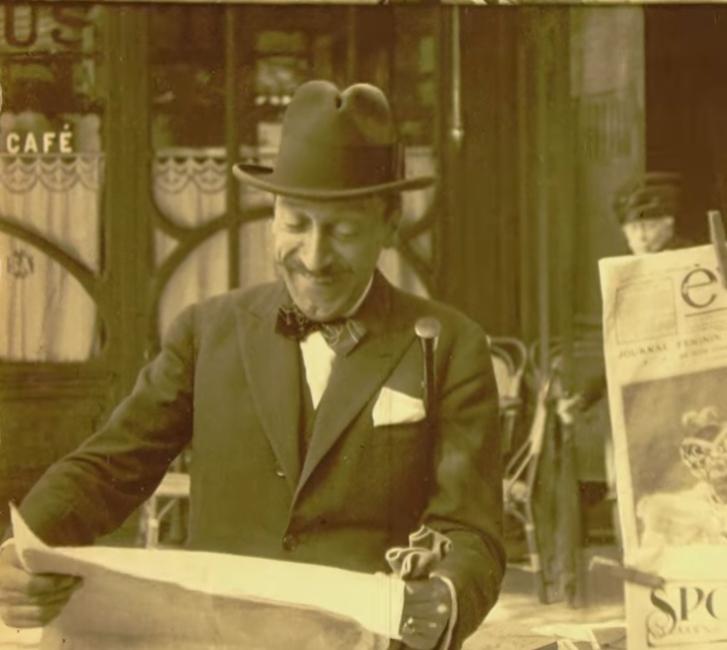
André Lefaur - 1921
They all give it their best shot but it’s hardly surprising to find them eclipsed by Boyer, Colbert, Melville Cooper and co. in the later American film. The one French performer to impress is close cropped Pierre Renoir (La nuit du carrefour’s Maigret) in the Basil Rathbone part, the leads’ contemptible former jailer (“Il n’y a plus de Tsar!”) who persuades them to use the fortune to save the oil fields of the homeland (represented by one drab shot of hay stacks) from the offer by rapacious imperialist diner guests, montaged to intrude leaning into Renoir's close-ups.

The editing is by Jean Delannoy and Henri Rust. The latter curiously also did Litvak’s version. It’s quite deft but can’t conceal the continuity errors with Lefaur’s pajama jacket. Close-ups reveal the on-set phone as a battered prop or emphasise the now useless cheque book thrown in the kitchen trash.

One is left with the probably correct impression of a cast of Boulevard theatre players turned loose in then busy designer Lucien Aguettand’s spacious, windowless movie studio decors.

There are untitled DVDs on this one but we do better with Deval’s 1936 Club de Femmes / French Girls’ Club, which is on You Tube in a passable copy with translation. It shows its director's familiarity with film form advanced. We open with yet another montage of converging train rails as young women with suitcases arrive in big city Paris. Mother Julienne Paroli tells her daughter to send money as soon as possible. However at the sleazy rooming house where the manageress assures the newcomer of respectability though the key to her door won’t be ready till the next day, a man’s feet are seen entering.

This situation can’t go on so a philanthropist whose statue adorns the entrance, sets up a guest house to be run by Eve Francis no less  (L’Herbier’s Eldorado) She has installed resident Doctor Valentine Tessier (Renoir’s Madam Bovary). Of the hundred and forty girls scampering around the pool and reading room in skimpy outfits, we get to know four.


Top billed Danielle Darieux, with twenty films already on her resumé at nineteen, is at her most pouty-winning. Easy to see why Henri Decoin and Albert Préjean were competing for her attention off set. She is determined to get her boyfriend into her room despite the no men rule and continues to be caught out by management. Francis reveals a soft heart demonstrated by carrying residents who can’t find the rent.

Club des femmes - Francis & Darieux
It’s one of our few glimpses of  Eve Francis who has an importance tangential to her acting career. She was the enthusiast to introduce Louis Delluc to movies, triggering his pioneering of Film Societies and Art Cinemas. I rate that as more important than her day job.
 Husband Henri Decoin & Darieux

Blonded Josette Day (Belle to Cocteau’s beast) is a steno who can’t spell so Else Argal, who keeps on getting gorgeous close-ups, intervenes. The actress was Mrs. Deval and would appear in only one other film, a bit part in Hollywood. She takes Josette in hand while reluctantly keeping those hands off. This is 1936 remember. The lesbian material, which is quite explicit if chaste, stopped the film getting registration in New York where it went on show anyway. Josette is a natural victim of the switchboard girl who is there to contact girls for her white slaver chums.

Australia’s own Betty Stockfeld (born in Sydney), then queen of the quota quickies, is  a willing customer of the operator. She came to Paris to exploit men who wanted her lovely white Norwegian (!) body - which isn’t anywhere near as well filmed. The operator’s underworld contacts have to buy her out of trouble when she tries to lift an American’s bankroll. She lands on her feet, about to marry the aging Lord Carringdale.

Smuggling the boyfriend in, got up as her girl cousin, past the remarkably gullible Francis and Tessier, means Danielle manages to meet her needs. The film gets by with only the one male character and for that poor Raymond Galle contributes a drag act that’s as plausible as Mrs Norman Bates. Meanwhile Day comes back distraught after some rough handling - a weeping naked in the shower scene. Argal determines to do something about it.

This sets up Tessier doing her “One day I will answer to the judgement of God though I avoid the judgement of men” complete with the prospect of joining a leperasarium and a nun on death watch - the only manifestation of religion the film manages. Club de Femmes is actually quite soft centered and moralistic despite its attempts to be scandalous. We get its “Je ne veux pas des chateaux” and final address by Francis in the snow.

The film form is increasingly assured as these plots converge with the squads of nubile young women making their way through the gleaming white decors that Aguettand has styled after the work of Lazare Meerson, who was also an influence on Cedric Gibbons in establishing MGM’s house style.

Prestige cameraman Jules Krauss and editor Jean Delannoy both get credits as director’s helpers. Like other celebrity writers - think Zane Grey, Robert Bolt, Sidney Sheldon and particularly James Clavell - Deval's movies are all but forgotten. He also did the 1950 Bernard Blier movie L'Invité du mardi - c'mon You Tube. You can do it!

The fact that the subject matter of Club de Femmes was considered sensational is one of the things that dates the piece but, like the conventions in which it is filmed, this also makes it one of the most accurate representations of thirties European popular entertainment and it does manage the shift from antique curiosity to attention grabbing melodrama. It deserves wider showing. 

If Deval's films are a footnote, they do make an intriguing one.

Colbert & Boyer      


Barrie Pattison 2021.


.


Sunday, 28 February 2021

One from the Archive : Mauprat.

During the French lockdown, the Cinémathèque Française is putting vault items on it’s “Henri“ Site. Jean Epstein’s 1926 Mauprat was still there the last time I looked. This one is ripe Cinémathèque material. It’s been restored since 2003 but I’ve never previously got a look at it.


Mauprat is an Elaborate and handsomely produced costume drama made by Epstein following his departure from the Russian émigre company Albatross, after directingThe Lion of the Mongols there, what must be Ivan Mozjoukine’s worst film. You’ll find little connection with maritime subjects like La Belle Nivraise  and Finis terrae that are the director’s best work.

The Russian link is still firmly in place with cameraman Albert Duverger and star Sandra Milovanoff, appearing between her touching Fantine/Cosette in Henri Fescourt’s 1925 Les Miserables & in René Clair’s 1925 Le fantôme du Moulin-Rouge & 1927 La proie du vent. She registers as an engaging presence, even with her habit of addressing her lines straight into the camera. Admiring Mlle Milovanoff, you can ponder whether Gal Gadot will seem as winning in ninety six years?

Mauprat is derived from a 1836 George Sand romance and shot in the author’s original Saint Sévène district - also the village that Tati used to film Jour de fete. The noble Mauprat family diverges into branches headed by an upright nobleman and his dissolute brother, both played by Maurice Schutz. Despite the efforts of the honest brother, one of his nephews has been raised by the rogue uncle surrounded by a band of grotesque outlaws.

The nobleman’s niece Milovanoff loses her horse out riding and takes shelter in the bandit’s castle where she is protected by now grown Mauprat heir Nino Constantini. Smitten, he extracts an oath of marriage from her in return for his aid - compare Lon Chaney in Benjamin Christensen’s 1927 Mockery along with the other violated promise movies of the day.


Troops and peasants besiege the outlaw strong hold but Constantini gets Milovanoff to safety. The attackers are all set to hang him but upright Schutz reclaims his lost nephew. “Now I can finally make him a gentleman” Comic scene of Constantini being dressed and powdered. Milovanoff’s fiancé Knight of La Marche Halma shows concern.  

Mauprat : Schutz & Constantini
Returning to his bandit clothes after discovering he is unable to have the object of his desire (“Je me tueras plutot” Sandra objects) from putting together the pieces of her torn letter, Constantini goes off to the war accompanied by forester with a fake beard Alex Allin (later in Le chapeau de paille d’Italie and Jean Renoir’s Les bas fonds) who leaves his loveable dog with Milovanoff, after she despatches the retainer to protect Constantini.

When Constantini returns he is involved in the machinations of the vilainous uncle but Allin has spotted the village girl supplying a fake monk who steals Milovanoff’s jewels. He exposes the plot. The lovers are united.

This one can hold it’s own with comparable period pieces like Epstein’s Robert Macaire or Renoir’s Le tournoi dans la cité. Top marks for settings and particularly costumes. The performances are quite modern but the hokey plot denies the piece any real impact. The war happens off screen and the siege is a muddled affair. Characters carry and occasionally wave their swords but we never get a duel. The most striking elements are incidentals - the train of Milovanoff’s dress brushing the wild flowers, the four way superimposed close up, the torn face powder mask.

Production assistant Luis Buñuel’s couple of walk-ons are his first movie activity. He later did insets for Epstein’s Chute de la maison Usher.

There are other vintage French films I’d rather have watched but Mauprat is OK enthusiast material. It is represented by a clear, mute, monochrome copy running close to the right speed, with original French captions. 


Barrie Pattison 2021


Tuesday, 26 January 2021

Old Movies

De Mille's Male & Female -Swanson, Daniels, Meighan & friend.


Card only box offices which were going in before Covid - no matter what they tell you -  combined with ragbag programming and Hollywood shuffling it’s prestige product to cable have meant my intake of theatrical first runs has dropped to a life time low. For better or for worse this has switched my attention to vintage material. I’m sorry I’m losing touch with the new face stars and film makers for the first time since I was a beardless youth. 

On the other hand, this new frame of reference is something that is welcome. The Talmadge Sisters and early De Mille hold no surprises for serious U.S. enthusiasts but for me this is catch-up time and by and large that’s good news.

De Mille’s silent Male and Female finally turned out to be grotesque and the 1930 Only Saps Work demonstrated Paramount’s bad judgement in believing Leon Errol could be funny for a whole movie but they represent the down side of raking through old Hollywood and even then you get a better grip on the work. On the other hand, as I’ve always suspected, received opinion was often not all that sharp. 

John Cromwell was an actor/producer who arrived in Hollywood from the East Coast with the wave of hopefuls drawn by the opportunities in sound film. Though the director proved winning in person, I’d never been all that enthusiastic about his movies, even though he managed to notch up a few like the Ronald Colman Prisoner of Zenda, Bogart’s Dead Reckonning and the out of character Ava Gardner portrait The Goddess. I’d like to see the 1945 short he split with Hitchcock and Elia Kazan. 

Accordingly  1930's The Mighty, Cromwell’s’s first solo director credit and near contemporary with All Quiet came as a surprise. It’s remarkable by any standard and extraordinary for it’s day, the work of people, for whom sound filming must have still been an intimidating novelty. The Mighty has a great central premise - Gangster George Bancroft is drafted and finds a front line unit is a great way to deploy his old skills. 

George Bancroft - Sternberg's Dragnet.

Bancroft had been conspicuous in silents, notably the James Cruze Pony Express. Von Sternberg cast him (third billing) in Underworld and he emerged the star with a couple more Von Sternbergs to come. A young Budd Schulberg thought he was a blow hard but Paramount featured him in their first sound films and, though Bancroft’s status declined, he was still personable in major films like Angels With Dirty Faces, North West Mounted Police and Stagecoach.  

The Mighty opens as troops march down Broadway to an “Over There” accelerated to match the silent speed footage and Bancroft and Raymond Hackett are in the crowd watching. George has to be prompted to take off his hat as The Flag passes. In a saloon, the camera travels the length of the bar with him, picking up individual conversations as it goes. In the back room, Warner Oland’s mob are plotting and George showily tears up his overdue draft notice (Fort Fleming). A team of MPs arrive but the bar man says he’s never heard of George, who comes out at that moment. A bar fly calls out his name, fingering our hero, and four soldiers have to get stuck in with Billy Clubs to subdue him. 

Like Deer Hunter there’s no training material, just a cut and, courtesy Wings stock footage, we’re in combat, where tough guy George has made sergeant. Though indifferent to the patriotic ideal (“fighting for the democrats!”), he’s totally in his element, while his young, upper class Lieutenant Morgan Farley (personal best for the perennial bit player, later the minister in High Noon)  quivers with nerves, despite his convictions. ”There’s a yellow streak down his back you could parade a company on” George, now become Captain, observes. Comes the big battle and they advance (impressive traveling camera crane) across a limited but convincing front line, with shell bursts and soldiers dropping all round - the film’s only process work is included, with smoke in front of the screen to disguise it. Farley dies a hero in George’s arms - telling scene. 

The Mighty - Morgan Farley
George promises to visit the dead officer’s family - cf. Lubitch’s much inferior Man I Killed.  Repatriated bemedaled, George is with his Doughboy mates (include Edgar Dearing & Jack Pennick) on the troop train, when he encounters Hatton, noting “There seems to be a band at every station”. He’s amazed at his stop off to find the reception is for him following Farley’s letters home - great traveling shot through the station entrance to the car, where the dead officer’s sister Esther Ralston waits for him. Hacket hops off the train to lead the cheering, sensing opportunity. Welcomed to their home by stilted dad, Australia’s own O.P.Heggie, George finds himself offered the job of police captain, to use his military methods to combat the reign of post war lawless elements. (prohibition is not mentioned) He’s persuaded and Oland and his gang show up to harvest the cluster of town banks, which would make a suitable target once the local criminal competitors are eliminated, “the biggest take in history” cf. The Big Caper

The Mighty - Ralston & Bancroft
 Of course George is attracted to Esther, understandably as she manages an appealing blonde vulnerable but alert persona, handling dialogue better than most of the East Coast Imports around her. He puts forward his notion that a war is a confrontation of gangs driven by loyalty and she counters that George Washington was someone who rejected the old allegiance for something more important. The town mobsters are disposed of and Warner sees his chance to do the bank job on his own. A complaining woman customer is puzzled, when the tellers all raise their hands but faints when she turns in camera direction. Floozy Dot Revier (also good) is sent in to warn George that she’ll rat him out to Esther if he interferes. Action climax, where George ignores the threat and leads the cop cars racing to the scene, while he cranks the siren. Shoot out on the roads and in the dark room streaked by chinks of light. Things end well (if unconvincingly). 

The only original music is under the titles but the extensive use of source music is remarkable - parades, under montages like the “War Ends” headlines or the Heroes’ welcomes. The film anticipates Henry King’s 1944 Wilson in this way.  The mix of plot themes that will animate the better action films to come, effective battle, small town staging and full-on confrontation of the new sound medium make this a large piece of neglected film history. Dialogue is still quite awkward, with the pause for effect before last words, labored. Bancroft has trouble with the significance-loaded speech, once he’s abandoned his “Fighting Fool from the gasworks” character but he gives it a good try and his physical presence is commanding. The adventurous handling is the antithesis of Cromwell’s conservative later work and this appears to be the peak achievement of his first period. It was also a great year for cameraman J. Roy Hunt adding this one and The Virginian to his c.v. 

The Mighty : Bancroft & Ralston.

Unlike MCA and these early Paramounts, Universal were notably apathetic towards their early films, burning their silent negatives and not bothering to put into theatrical re-issue anything other than their ”Horror” films and a few westerns among their early sound output. The rest remain largely unknown though a few were made up in bundles for late night TV, some making their way to Australia in the sixtties. That’s how I saw the early William Wylers. 

Monta Bell’s 1931 Up For Murder comes out of this void. Bell had been a prestige silent film maker working with Garbo, Gilbert and Jeanne Eagles. The opening of his Personal Maid where they load the camera into a dumb waiter and take it up a tenement where residents are arguing with one another on every level is a great piece of imaginative staging. Unfortunately nothing else in that film is as good. By the time we get to Up for Murder, Hollywood’s re-tooling for sound is pretty much complete and the piece is surprisingly assured for a now totally forgotten early sound film. Working on the opening scenes’ real news paper presses, young (the film is supposed to end with his 21st birthday) Lew Ayres takes no interest when the switch board blonde comes on for him. He is hit up for a two dollar loan by drunken reporter Frank McHugh who in return suggests to editor Frederick Burt he should take Lew on as a journalist. Shown to a desk with a typewriter, Lew asks what he should write but Burt scornfully calls him “Kipling” and has him checking lists. His twenty dollar pay check is a marvel to Lew, stuffing notes into mother Dorothy Petersen’s cookie jar. 
 
There’s one brief scene of management laying out the edition to give prominence to the sensationalist stories. Bell had worked in newpapers. 

Then in the first of the film’s hard to swallow developments, glamorous Society Editor Genevieve Tobin, who has lost her flair since she became publisher Purnell Prat’s Tootsie, needs to be squired to the Mayor’s ball and spots Lew at the back of the office. They get him a voucher from accounts to hire a diner suit (which fits perfectly) and he’s off in his top hat with Genevieve on his arm. Pratt with his family are in the loges and Polly Ann Young his daughter notes that Genevieve’s jewels are real. So rapt is Lew that he just has to write up an account of his big night and this gets scooped out of his typewriter and run next to Genevieve’s routine coverage. He comes on for her (understandable) and gets her to a picnic at the zoo, taking her to his favorite view point over the city. They go back to her flat and she emerges in her glittery cape over lingerie outfit but Lew is put off and leaves - thus winning her over. They plan on spending an evening together but Pratt wants her that night and she stalls Lew who turns up anyway with Pratt putting him in his place in the film’s strongest scene. ”Maybe you’ll pay her rent next month.” 

Up for Murder -  Tobin & Ayres in Charles Hall decor.
In a scuffle, Pratt falls hitting his head and dies. Genevieve gets Lew out and calls editor Richard Tucker who goes into fixer mode to protect the paper’s reputation, having the body transferred to the office and claiming he heard an argument in the next suite there. His attempt to square away the murder on an unknown is scuppered when Lew insists on confessing without giving details. Third Degree scene - (cops with Robert Emmett O'Connor prominent, assuring the kid “We’re your friends” while fiddling with the spotlight) and Tucker, who promises to get Lew off, arriving and adding in detail about Ayres and Pratt arguing because the kid was a dangerous radical cf. Rozalind Russell's great scene with John Qualen in 1940’s His Girl Friday or the Larry Parkes sub plot in Sam Fuller’s 1943 Power of the Press script. The judge reads out a guilty verdict and Lew is in the cells playing solitaire on his blanket as they march a condemned man on his last mile with the preacher - montage of close-ups of the other inmates, including yet another single black prisoner, all shouting “Take me!” 

At this point Genevieve cracks, precipitating a totally incredible happy ending. Pity this finale is so cursory because the simple handling in realist decors and the performances have held interest well. The film’s strength is a beautiful turn by Tobin managing just the right amount of world weariness to to go with her glamour. Attractive and having what we can recognise as the Broadway delivery then familiar from Helen Hayes or Ruth Chatterton, Tobin was a talent largely wasted by Hollywood. Her lively Mimi in One Hour With You is the character she has here, played for exuberance rather than resignation. She did co-star with Jack Hulbert in a forgettable English movie along with her dispiriting support roles in subsequent US productions. She and Ayres make an involving couple. 

Putting it where his mouth was comes WW2 and Lew Ayres, star of the great pacifist classic All Quiet on the Western Front, refused combat service and became an army medic.

Still the fresh faced Karl of All Quiet..., Ayres would manage to continue re-inventing himself, MGM’s young Dr. Kildare, Johnny Belinda, Battleship Gallactica. The playing is so good that McHugh and Peterson doing their type casting drunk reporter and suffering mum characters actually manage to convince - especially when they are on screen together. The handling is straight forward with even a few rough touches like an out of focus linking shot but the celebrity technicians manage to hint at their presence - Carl Freund, the light master of the German silent film and cameraman on Dracula and The Good Earth here at a point where he was about to launch his brief but intriguing career as director, contributes what looks like a snatch of hand held running in the dark street with Ayres while Charles Hall offers the high fashion decorating of Tobin’s apartment. Radio source music buts a snatch of what sounds like Bing Crosby onto an orchestral of Ed. Goulding’s “Mam'zelle” number. This is well on the way to being Bell’s most assured film. 

Old Hollywood - there’s more of this material than any one person can hope to see in a lifetime. Take my word for that. Discovering it is nearly as good as watching it.

Barie Pattison - 2020